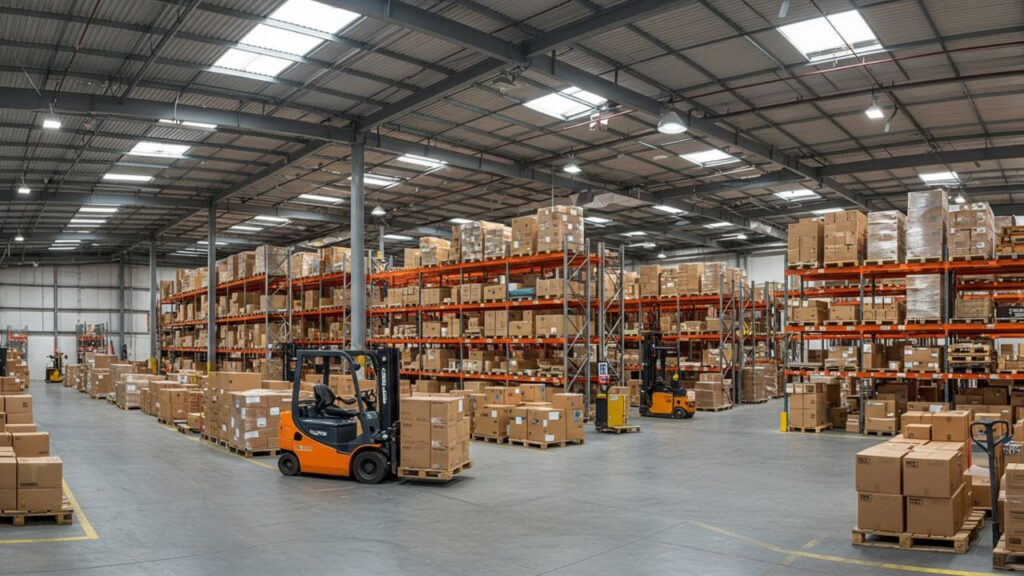
Modern warehouses and workshops are under increasing pressure to maximise performance within limited space. Rising industrial land costs across Australia, combined with tighter delivery expectations, have made inefficient layouts costly to maintain. At the same time, inventory has become more complex, with higher SKU counts, mixed load types, and fluctuating stock levels. These factors are pushing businesses to reassess how their warehouse storage system is designed, managed, and adapted for future operational demands.
This article is based on independent research drawing from Australian government agencies, industry associations, academic studies, and professional publications. It does not claim first-hand installation or operational experience. Readers should consult qualified storage engineers and safety professionals before implementing any warehouse or workshop storage system.
What Is a Warehouse Storage System?
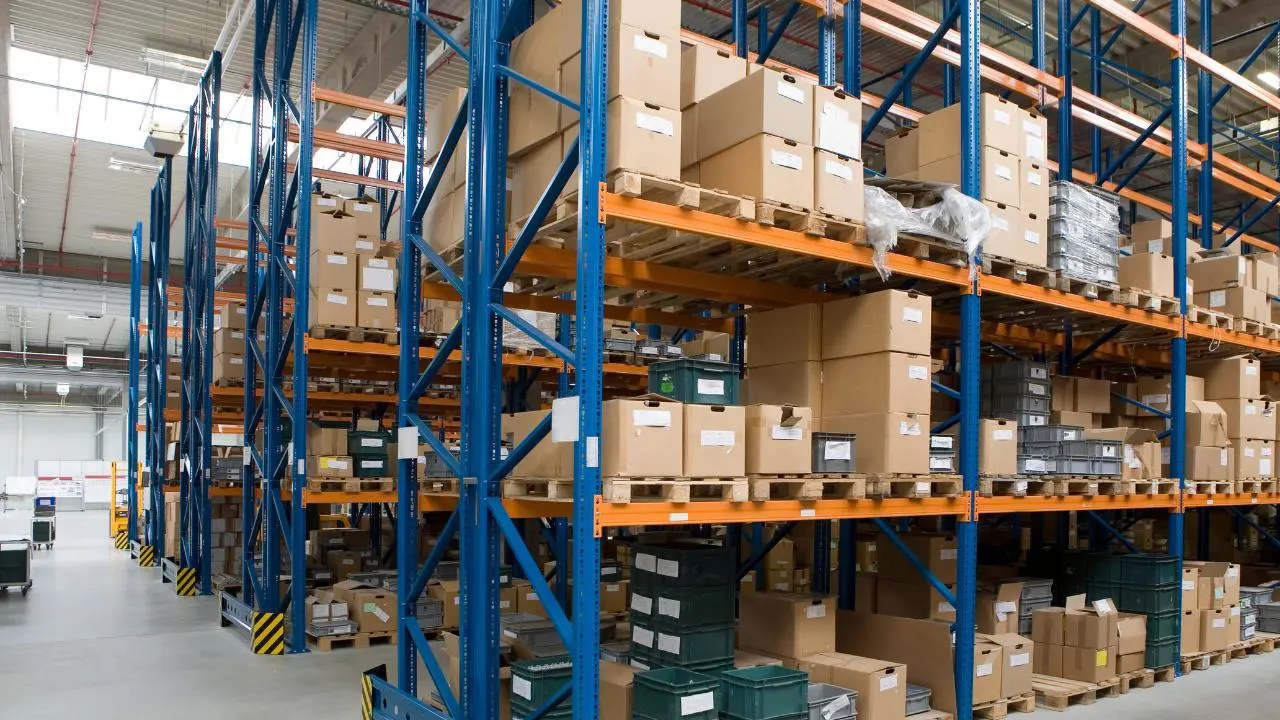
A warehouse storage system refers to the physical framework and technology used to store inventory safely and efficiently within a facility. It encompasses both heavy-duty racking systems, such as pallet racking, and compact storage modules, as well as digital components like warehouse management software. The right system supports better space utilisation, faster picking and packing, and improved inventory visibility.
Industrial storage systems come in many forms, from traditional selective pallet racks to automated, high-density configurations and integrated smart systems that feed real-time data into operations.
Why Warehouse Storage Optimisation Matters in 2026
According to the Australian Bureau of Statistics, Warehousing and logistics demand continues to rise alongside e-commerce growth and manufacturing recovery, particularly in New South Wales. At the same time, industrial land supply in Sydney remains constrained, increasing the cost of inefficient layouts.
According to Australian WorkSafe guidelines, industry research shows that poorly matched racking and storage layouts can reduce usable warehouse capacity by 20 to 30 percent. As a result, warehouse storage system optimization has become a critical lever for cost control, safety compliance, and long-term scalability.
Key Drivers Shaping Storage Design
Industry consensus suggests that future-ready facilities prioritise:
- Vertical space utilisation
- Flexible reconfiguration
- Integration with warehouse management systems (WMS)
- Compliance with Australian safety standards
Benefits of Storage System Optimisation
Industry data and professional guidance consistently show that optimising storage systems leads to measurable operational benefits.
- Space savings: High-density storage systems increase usable capacity without expanding the building footprint.
- Improved workflow: Smart storage combined with software reduces manual handling and improves order fulfilment speed.
- Better inventory accuracy: Digital tracking improves visibility, reducing mis-picks and stock shortages.
- Scalability: Modular and automated systems allow warehouses to grow with demand without major redesigns.
How Modern Warehouse Storage Systems Work
A warehouse storage system is not a single product. It is a coordinated combination of structural systems, handling equipment, automation, and operational processes.
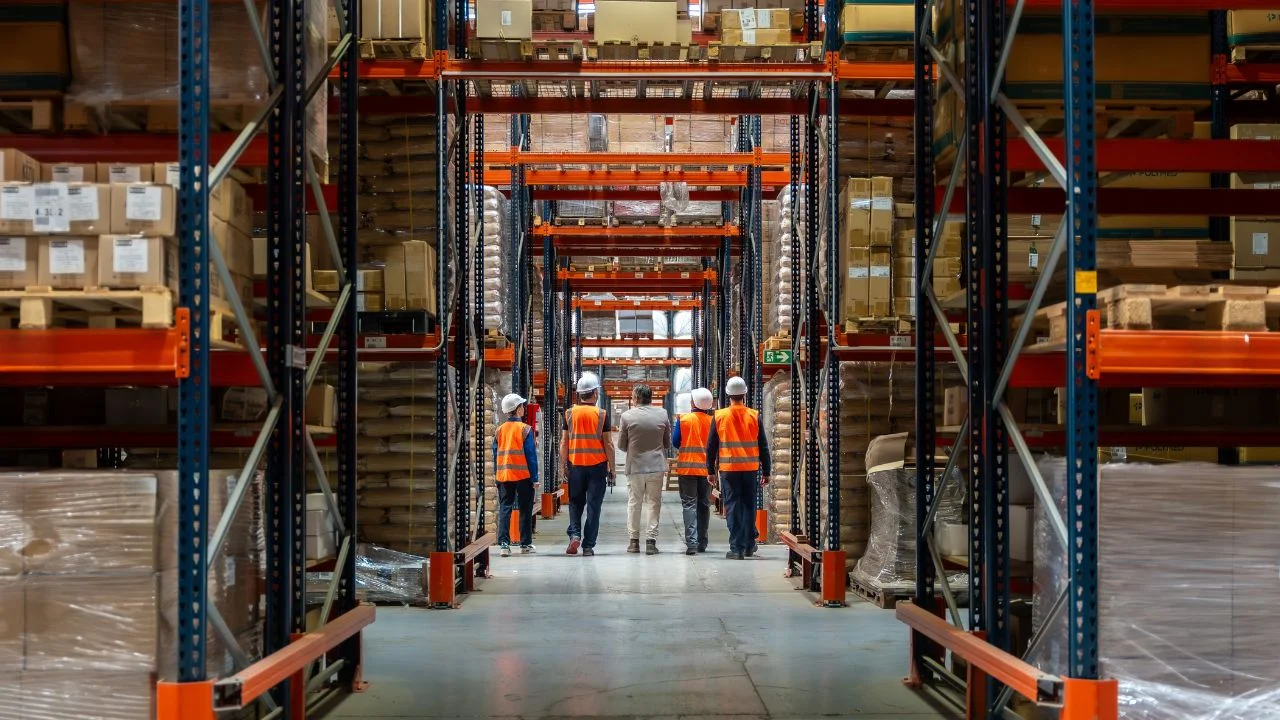
Guidelines from Australian safety authorities emphasise that storage systems must suit load types, handling methods, and traffic flows to minimise risk and maximise efficiency.
1. Structural Storage Systems
These include pallet racking, shelving, cantilever racking, and mezzanine floors. Structural design must account for load ratings, seismic considerations, and forklift impact zones, particularly in high-density environments.
2. Handling Integration
Storage layouts must align with forklifts, automated guided vehicles (AGVs), or manual picking methods. Poor alignment between racking design and handling equipment is shown to increase picking times and operational delays.
3. Digital Coordination
Smart warehouse storage increasingly integrates with WMS software to optimize slotting, replenishment, and inventory visibility. Data-driven slotting is now considered best practice for medium to large facilities.
Different Warehouse Storage Solutions
Different warehouses require different storage strategies depending on SKU velocity, pallet diversity, and growth forecasts.
| Storage Solution | Best Use Case | Advantages | Limitations |
| Selective Pallet Racking | Mixed SKUs, fast access | Direct pallet access, flexible | Lower storage density |
| Drive-In / Drive-Through Racking | High-volume, low SKU | High-density storage | Reduced selectivity |
| Cantilever Racking | Long or bulky items | Ideal for timber and steel | Space intensive |
| Mobile Racking | Space-constrained facilities | Maximises floor space | Higher upfront cost |
| Mezzanine Systems | Vertical expansion | Adds usable levels | Structural constraints |
According to Standards Australia’s AS 4084:2021, all pallet racking systems must be engineered, installed, and inspected according to specific load capacity and safety requirements.
Smart Warehouse Storage and Automation in 2026
Smart warehouse storage merges physical systems with digital technology. A smart warehouse uses connected software, automation, and data analytics to improve every stage of storage and retrieval. Smart warehouses can reduce fulfillment costs, automate inventory tracking, and provide insights that inform layout changes.
In practice, this could involve implementing RFID tagging to automate stock counts or integrating automated storage and retrieval systems (ASRS) to expedite order picking and minimize human error. These technologies help warehouses handle higher volumes and tighter delivery windows without proportionally increasing staffing or space.
Smart Warehouse Storage At a Glance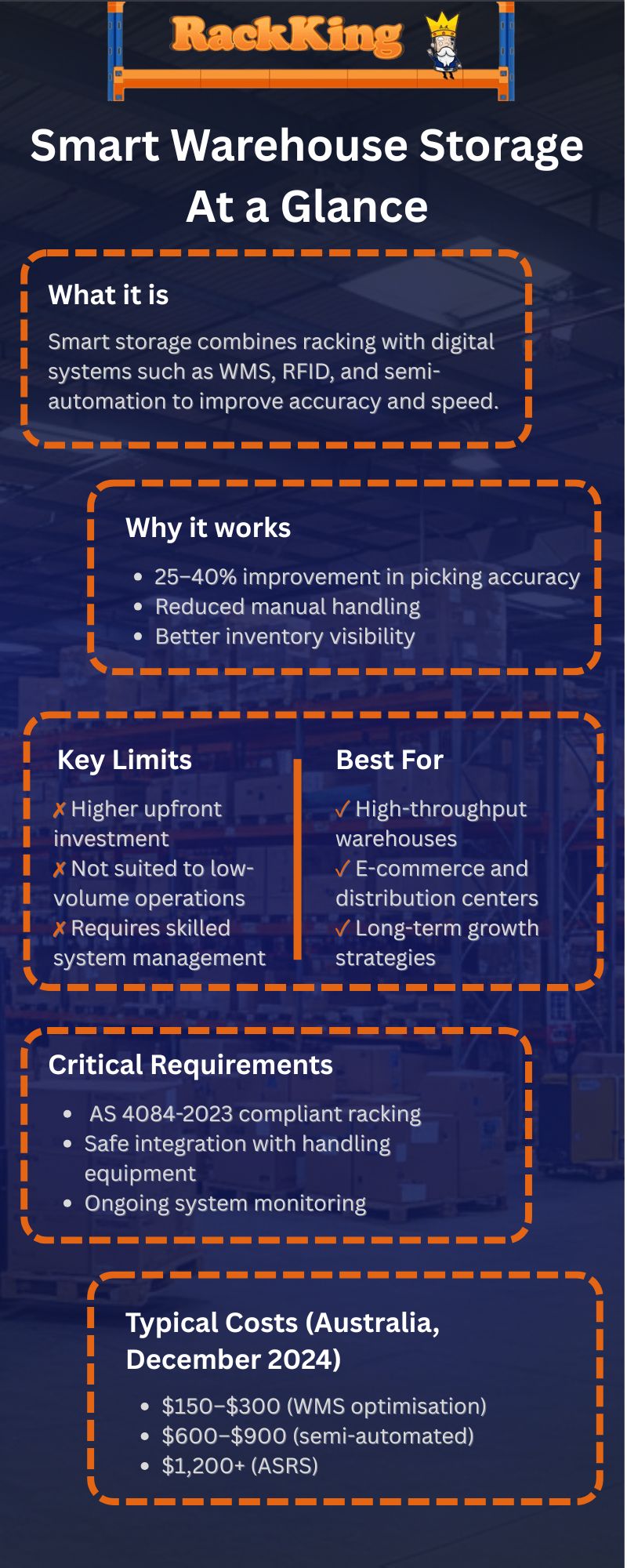
Practical Guidance Based on Industry Standards
Based on professional guidelines from Safe Work Australia, WorkSafe NSW, and logistics industry bodies, successful storage optimisation projects typically include the following considerations:
Before implementation:
- Verify load ratings and engineering certification
- Assess future SKU and volume growth
- Confirm compatibility with handling equipment
- Ensure compliance with AS 4084:2023
Conclusion
Optimising warehouse and workshop storage is no longer just about using space efficiently. As Australian operations strive for higher efficiency, stricter safety compliance, and scalable growth in 2026, selecting the right warehouse storage system is a strategic decision.
Research from industry bodies and safety authorities shows that well-designed industrial storage solutions improve workflow, reduce handling risks, and support long-term flexibility. Whether you are considering high-density storage, workshop storage optimisation, or smart warehouse storage, success depends on correct system selection and compliance with Australian standards.
If you are planning to upgrade or redesign your storage in Sydney or across Australia, RackKing can help identify compliant and scalable solutions suited to your operational needs.
Related Articles
Warehouse Racking Types & Benefits Guide Australia
Why Racking Solutions Are Better For Warehouse Storage And Flow?
FAQs
What is the most efficient warehouse storage system for space utilisation?
Guidance from Safe Work Australia and logistics industry publications indicates that high-density systems, such as drive-in and mobile racking, offer the highest space utilisation. However, these systems must be balanced with accessibility, throughput, and safe handling requirements to maintain efficient operations.
How often should warehouse racking be inspected in Australia?
WorkSafe NSW guidelines recommend regular visual inspections and formal annual audits conducted by competent persons, with immediate action taken if damage is identified.
Can workshop storage optimization really improve productivity?
Research from Safe Work Australia indicates that organised workshop storage improves workflow efficiency while reducing injury risk, particularly in manufacturing and maintenance environments.