
Warehouse inspection is not just a routine safety task. In Australia, it plays a direct role in preventing workplace injuries, reducing operational downtime, and meeting legal obligations under work health and safety laws. For warehouses across Australia, regular inspection of pallet racking systems is especially critical due to the high risks associated with structural failure, forklift impacts, and overloading. Poor inspection practices can lead to accidents, stock loss, penalties and compromised compliance with standards like AS 4084.
This guide is based on extensive research, including Australian Standards, government regulatory guidance, industry inspection practices and expert insights. This article explains why inspections matter, what regulations apply, how to conduct them, typical checklists used by professionals, common issues inspectors find, audit procedures and best practices.
What Is a Warehouse Inspection?
A warehouse inspection is a structured process used to identify hazards, assess compliance with safety standards, and confirm that storage systems are fit for continued use. It typically covers:
- Building and floor conditions
- Traffic management and aisles
- Material handling equipment
- Fire safety systems
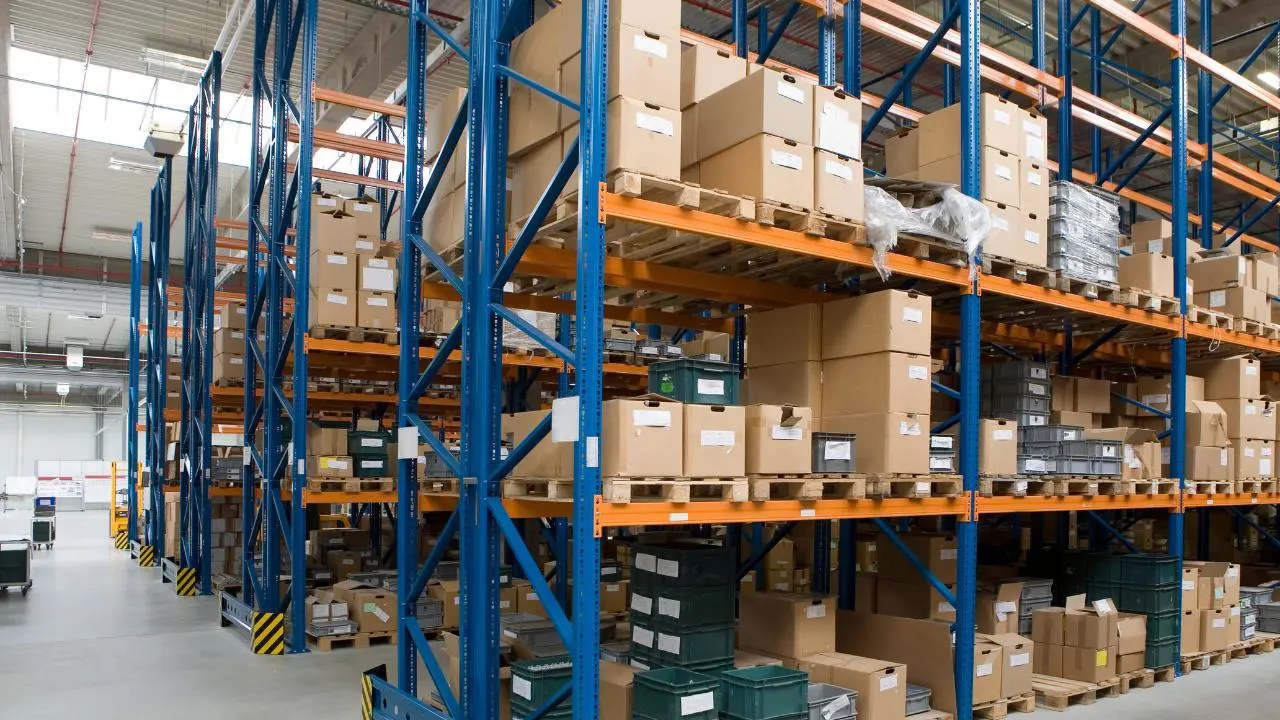
- Storage structures such as pallet racking
Within this broader process, warehouse racking inspection focuses specifically on the condition, installation, and use of racking systems. According to Safe Work Australia, storage racking failures are a known cause of serious injuries and fatalities in warehouses, particularly when damaged racking is not identified and repaired in time.
Why Warehouse Inspections and Racking Safety Matter
Warehouse inspections go beyond routine housekeeping. They help teams detect issues early, protect workers, and meet legal duties. Pallet racking safety is a critical component of workplace safety management in Australia. Work health and safety (WHS) laws require that structures and plants, including pallet racking, are “without risks to health and safety.” Regular inspections confirm that your storage system meets that duty.
A failed rack can lead to a collapse, which might cause severe injury, stock loss, significant downtime, and costly insurance claims or work stoppages. In tight urban environments like Sydney, these impacts ripple quickly through operations.
Risks of Neglecting Inspection
If warehouse racking is overloaded, misaligned or damaged without detection, the consequences can include:
- Structural failure under load, leading to collapse.
- Serious injuries or fatalities to staff from falling pallets or racking elements.
- Stock loss and operational downtime from impacted inventory and inaccessible aisles.
- Regulatory penalties under Work Health and Safety (WHS) laws.
- Insurance issues, since failure to inspect per standards can jeopardise coverage.
For Australian warehouses operating under WHS legislation and Australian Standards, inspections are a central part of managing these risks. Maintaining pallet racking safety through regular inspections is not just best practice; it’s a legal and operational necessity.
Warehouse Racking Regulations: Australian Standards and Workplace Safety Law
Australia does not have a specific national law that mandates pallet racking standards, but WHS laws require that plants and structures be safe and without health risk. Inspecting pallet racking is the most accepted way to demonstrate compliance with that obligation.
Australian Standard AS 4084
The key technical reference for pallet racking in Australia is AS 4084, which covers steel storage racking. The 2023 update splits it into two parts:
- AS 4084.1:2023 – Design: Structural specifications, load considerations and engineering requirements.
- AS 4084.2:2023 – Operation and Maintenance: Inspection regimes, damage assessment, repair rules and documentation.
These standards are developed by Standards Australia and widely adopted as benchmarking documents for safe storage systems in warehouses. While they are standards rather than legislation, compliance with them is the accepted means of meeting WHS obligations and can influence insurance requirements.
Work Health and Safety (WHS) Laws
Under the WHS Act, employers have a duty to provide a safe working environment. Safe Work Australia explicitly lists storage racking as a plant that must be maintained in a safe condition .
Failure to inspect and maintain racking may be considered a breach of WHS duties, even if no incident has occurred.
Types of Inspections: From Daily Checks to Formal Audits
Warehouse inspection is not a single event. Effective safety and compliance programs use multiple layers of inspection:
1. Daily/Shift-Level Checks
Carried out by operators during daily routines, focusing on obvious damage (e.g., fresh impact marks, dislodged beams). These checks help catch new issues quickly.
2. Routine Internal Checks
Performed by supervisors or trained staff on a weekly or monthly schedule. These reviews use a checklist to look for structural and operational concerns.
3. Formal Professional Inspection or Audit
A comprehensive pallet racking audit and inspection is carried out by a competent person at least once every 12 months, often required to meet Australian Standards and demonstrate compliance to WHS regulators and insurers.
4. Post‑Incident Inspection
Triggered after a specific event such as a forklift impact or seismic event, focusing on assessing damage and re‑establishing safe conditions.
Each of these contributes to safety: routine checks catch early signs, while formal audits check compliance with technical standards.
Pallet Racking Inspection Checklist
An effective pallet racking inspection checklist helps teams standardise reviews and identify non-compliant conditions early. This checklist synthesizes regulatory guidance, standards, and industry inspection practices.
Structural Components
- Inspect uprights and frames for bends, cracks, twisting, or misalignment, and ensure all bracing is intact and undamaged.
- Check beams and connectors for deflection or overloading, and confirm that connectors are secure with safety clips or locking pins in place.
- Verify that floor anchoring and baseplates are firmly fixed, undamaged, and correctly seated on the floor.
- Ensure load signage is clearly visible, legible, and matches the approved Safe Working Load (SWL) documentation.
- Record and tag any damage or impact marks, such as dents, corrosion, or scrape marks, for repair or isolation.
- Review housekeeping to ensure aisles are clear and pallets are stored correctly within rack boundaries without overhang.
Step-by-Step Warehouse Racking Inspection Process
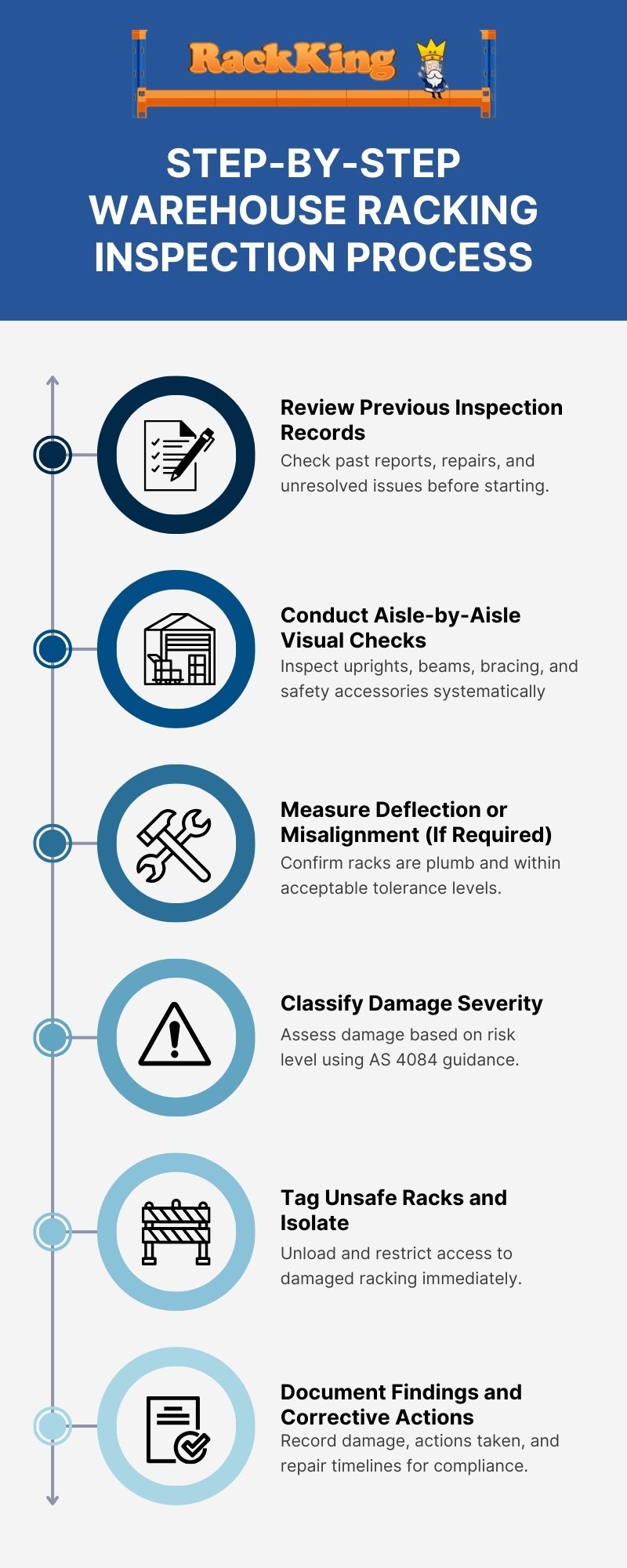
Common Issues Found During Inspections
Research and regulator reports consistently identify recurring issues:
- Forklift impact damage
- Missing beam locks
- Overloaded bays
- Poor floor anchoring
- Inadequate rack protection
WorkSafe NSW reports that impact damage is one of the most common contributors to racking failure in Australian warehouses.
Preparing for a Warehouse Audit or Regulator Visit
Based on regulator guidance, preparation for a pallet racking audit should focus on documentation and evidence
Key preparation steps:
- Maintain inspection records
- Keep repair documentation
- Ensure load signage is current
- Confirm staff training records
- Address outstanding high-risk defects
Warehouse Audits Procedures
A warehouse audit goes beyond checklist scanning. It’s a systematic evaluation of safety, compliance and documentation.
Typical Audit Steps
- Pre-audit preparation involves gathering layout drawings, load ratings, and previous inspection reports while identifying high-risk areas such as high-traffic aisles or variable load zones.
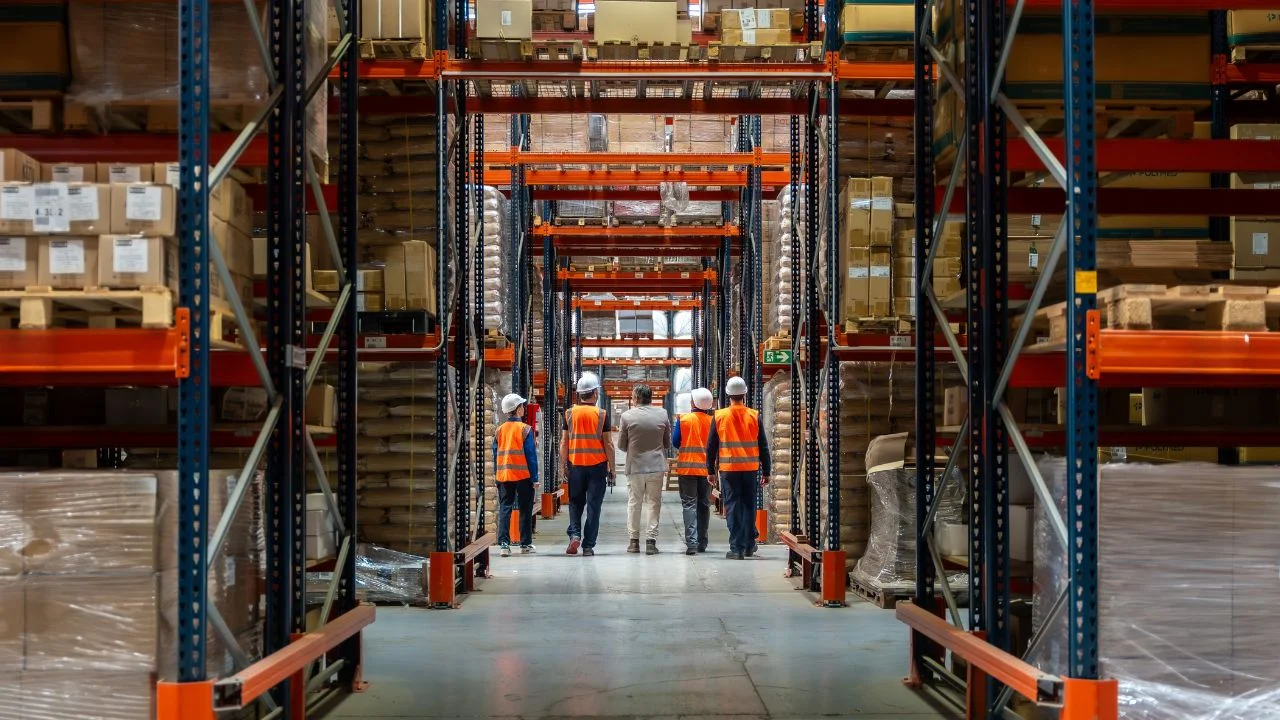
- Walk-through inspection includes a full site review of all racking runs using a structured checklist, supported by photos and basic measurements to accurately record defects.
- The inspector reviews documentation, verifies that load signage matches the design, and maintains past inspection records and corrective actions.
- For risk classification, the inspector assesses each finding by severity and determines whether to carry out immediate repair, implement monitoring, or take no action.
- The inspector compiles the report and recommendations into a clear written document outlining required actions, responsibilities, deadlines, and overall compliance with AS 4084 and WHS obligations.
Warehouse Inspection vs Warehouse Audit
Although often used interchangeably, warehouse inspection and warehouse audit are not the same. Key Differences:
- Inspections focus on identifying physical damage and hazards
- Audits assess systems, documentation, training, and compliance processes
A warehouse audit typically reviews inspection records, risk assessments, and corrective action tracking.
| Factor | Routine Warehouse Inspection | Warehouse Audit |
| Purpose | Identify physical hazards | Verify compliance and systems |
| Frequency | Daily, weekly, monthly | Usually annual |
| Performed By | Warehouse staff or trained inspectors | Independent or senior compliance personnel |
| Scope | Racking, aisles, visible risks | Records, training, procedures |
| Outcome | Immediate corrective actions | Compliance recommendations |
Training and Competency Requirements
A competent person must carry out inspections as specified by AS 4084. According to WorkSafe Victoria, competency for pallet racking safety includes understanding racking systems, damage assessment, and load capacity principles.
Many organisations use a mix of:
- Trained in-house inspectors for routine checks
- Independent professionals for annual audits
Conclusion
Warehouse inspection, especially of pallet racking systems, is essential for safety, compliance and performance in Sydney and across Australia. A layered inspection strategy that includes daily operator checks, regular internal reviews and annual professional audits provides the best defence against accidents and regulatory risk. Compliance with AS 4084 and WHS laws helps protect staff, inventory and the business as a whole.
Regular documentation, clear reporting and prompt corrective actions turn inspection from a routine task into an effective risk management practice. For warehouse managers, safety officers and compliance teams, building a structured and documented inspection system is not optional but a core part of operational excellence.
Need professional pallet racking inspection and audit services or compliant storage solutions for your warehouse? RackKing offers expert inspection services, AS 4084-compliant racking systems, and comprehensive safety solutions across Australia. Contact our team today for a free consultation and ensure your warehouse meets all safety standards.
Related Articles
Proper Pallet Racking Installation for Safe Warehouses
Warehouse Racking Australia: Holiday-Ready Safety Guide
FAQs
How often should pallet racking be inspected?
According to AS 4084 standards and industry guidance, pallet racking should be formally inspected by a competent person at least once every 12 months. Between formal audits, routine checks by trained staff (weekly/monthly) help catch emerging issues early.
What should you do if racking fails inspection?
Damaged or non-compliant racking should be unloaded and isolated until repaired. Only return it to service once a qualified inspector confirms it meets safety requirements.
Who is qualified to perform a pallet racking inspection?
A competent person or trained professional familiar with AS 4084, WHS regulations and structural inspection practices should conduct formal audits. Internal visual checks can be performed by trained warehouse staff as part of routine safety duties.