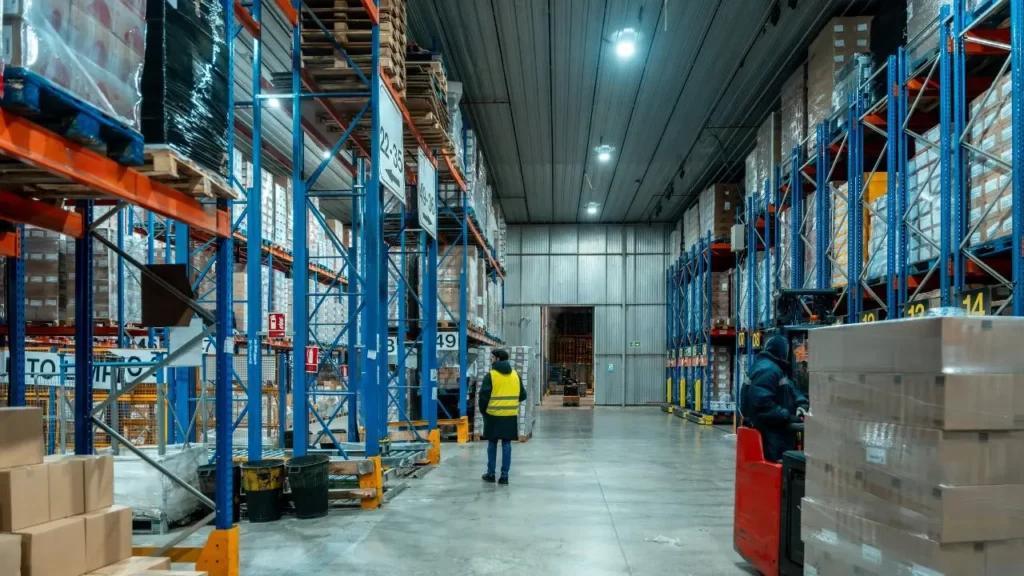
For Australian warehouse operators, fire risk is not theoretical. It affects life safety, business continuity, insurance cover and regulatory exposure. Under the Australian Building Codes Board framework, warehouse fire design and performance requirements are embedded in the National Construction Code. Separate duties also arise under work health and safety law. This guide is designed to help you understand how warehouse fire safety standards work in practice, drawing on current NCC provisions, Australian Standards, and guidance from Australian state regulators.
For owners, facility managers and 3PL operators, understanding warehouse fire compliance is about more than passing inspections. It reduces operational downtime, supports insurer expectations and strengthens overall workplace safety.
Understanding Warehouse Fire Safety Regulations in Australia
Key Regulatory Frameworks: NCC, AS Standards, and State Requirements
In Australia, warehouse fire safety sits primarily under the National Construction Code (NCC), administered by the Australian Building Codes Board. The NCC sets minimum performance requirements for fire resistance, detection, suppression and egress in Class 7b buildings, which typically include warehouses.
The NCC references Australian Standards such as:
- AS 2118 series for automatic sprinkler installations
- AS 2419 for fire hydrant installations
- AS 1670 for fire detection and alarm systems
- AS 1851 for the routine service of fire protection systems
The current NCC can be accessed via the Australian Building Codes Board website. According to the NCC 2022 Volume One, fire safety provisions address fire compartmentation, structural fire resistance levels, smoke hazard management and occupant egress.
From a work health and safety perspective, duties arise under model WHS laws published by Safe Work Australia. These require persons conducting a business or undertaking to eliminate or minimise fire risks so far as reasonably practicable. State fire authorities, such as Fire and Rescue NSW, provide additional operational guidance on hydrant access, brigade connections and emergency planning.
Compliance Assessment, Enforcement, and Alignment with WHS
Compliance is typically assessed at development approval, construction certification and through periodic inspections. Local councils and private certifiers enforce NCC compliance. Fire authorities may audit essential fire safety measures.
Failure to meet warehouse fire compliance obligations can result in:
- Rectification notices
- Increased insurance premiums or declined claims
- WHS prosecution in the event of injury
For warehouse operators, regulatory, insurance and WHS requirements operate together rather than separately.
Key Warehouse Fire Safety Requirements
Under the NCC, the minimum warehouse fire safety standards for Class 7b buildings depend on floor area, fire load, storage height and risk profile. Core requirements typically include:
1. Fire Resistance and Compartmentation
Structural elements must achieve prescribed Fire Resistance Levels (FRLs). Fire walls and separation distances limit fire spread between tenancies.
2. Egress and Emergency Lighting
Exit numbers, travel distances and discharge paths must comply with NCC performance provisions. Emergency lighting and illuminated exit signage are required in most warehouses to support evacuation during power failure. Safe egress depends on a well-considered warehouse layout design, clear aisle widths, unobstructed pathways and logical flow all contribute to effective evacuation routes.
3. Fire Detection and Alarm Systems
Depending on building size and risk, automatic detection under AS 1670 may be required. This forms part of integrated warehouse fire alarm systems.
4. Fire Suppression Systems
Many warehouses require automatic warehouse sprinkler systems under AS 2118, particularly where floor areas exceed certain thresholds or where high-piled storage is present. Storage height and racking configuration directly influence suppression design. Operators should review their warehouse racking types to ensure systems are correctly matched to their storage profile.
5. Fire Hydrant and Hose Reel Systems
AS 2419 governs fire hydrant systems, warehouse installations, ensuring adequate flow and coverage for brigade operations. Legal minimums differ from best practice. For example, while some smaller warehouses may not strictly require high-performance suppression, insurers or tenants may mandate enhanced warehouse fire protection systems based on risk engineering assessments.
According to Queensland Fire and Emergency Services, effective fire safety design must consider ignition sources, stored commodities and building layout, not just floor area.
Warehouse Fire Protection Systems Explained
Warehouse Sprinkler Systems
Automatic warehouse sprinkler systems are one of the most significant life and property protection measures. The NCC references AS 2118, which sets out design densities, spacing and water supply requirements. The Australasian Fire and Emergency Service Authorities Council consistently highlights sprinkler effectiveness in containing industrial fires before brigade arrival.
Sprinkler types in warehouses typically include:
- Conventional wet pipe systems
- Dry pipe systems for cold environments
- Deluge systems for high-hazard areas
Common design mistakes, identified in technical guidance from the Fire Protection Association Australia, include:
- Incorrect hazard classification
- Inadequate water supply or pump capacity
- Obstructions from racking or services
These errors can compromise warehouse fire compliance and insurer approval. Racking obstructions are a particularly common issue; poorly installed or damaged racking can deflect sprinkler coverage. Operators should follow compliant racking installation rules to avoid inadvertently compromising suppression systems. Professional hydraulic design and independent certification are critical.
ESFR Sprinklers for High-Risk/High-Piled Warehouses
ESFR sprinkler systems (Early Suppression Fast Response) are specifically designed for high-piled storage and rapid fire growth scenarios. Unlike conventional sprinklers that control a fire, ESFR systems aim to suppress it early without requiring in-rack sprinklers.
According to technical guidance from the Fire Protection Association Australia, ESFR is commonly used in:
- High-bay warehouses
- Plastic and cartonised storage
- Distribution centres with tall racking
ESFR systems require strict compliance with ceiling height, deflector clearance and commodity classification rules under AS 2118. Incorrect installation can invalidate performance assumptions.
For facilities storing high fire load materials, insurers often prefer ESFR or enhanced suppression within broader mining material handling systems or logistics environments where combustible packaging is common. Operators running heavy-duty storage operations should also review dedicated mining racking systems guidance for sector-specific compliance considerations.
Fire Alarm and Detection Systems
Modern warehouse fire alarm systems are governed by AS 1670. They may include:
- Smoke detectors
- Heat detectors
- Beam detectors for large open spaces
- Aspirating systems for early detection
Detection systems are often monitored by off-site alarm monitoring services to ensure rapid brigade notification. Fire and Rescue NSW emphasises that early detection significantly reduces property damage and life risk. Integration between detection and suppression is critical in large logistics facilities.
Fire Hydrant Systems
Compliant fire hydrant systems warehouse installations under AS 2419 provide adequate water flow for brigade operations. Hydrants must be accessible, clearly marked and unobstructed. Both internal and external hydrants are commonly required in large warehouses to meet warehouse fire safety standards and support emergency response.
Assessing Fire Risk and Considerations for Warehouse Types
Fire risk varies significantly by warehouse type. Research from the Australasian Fire and Emergency Service Authorities Council shows that storage height and commodity type are primary drivers of fire intensity.
Key risk factors include:
High-bay and high-piled storage
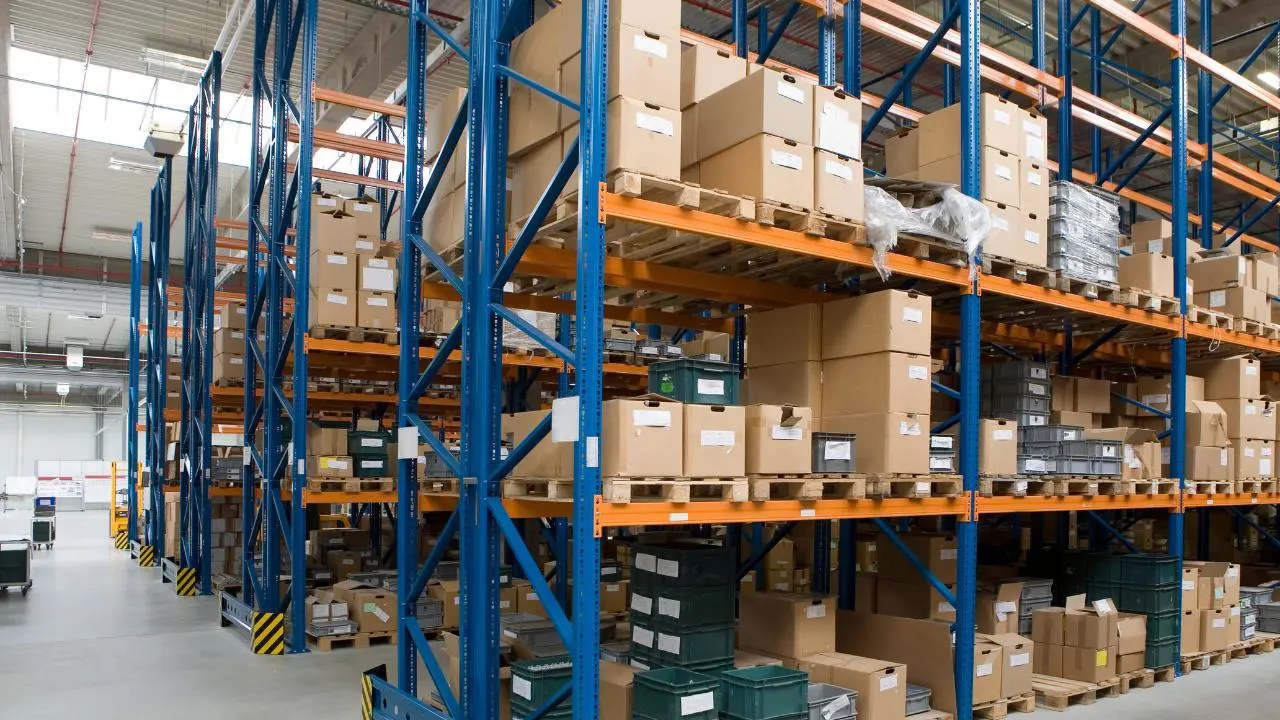
Tall racking increases fire spread potential and can challenge standard warehouse sprinkler systems unless designed correctly. Understanding different racking solutions helps operators make informed decisions about storage configuration and its fire risk implications.
Cold storage facilities
Insulated panels, particularly older combustible cores, have been associated with severe fire events. Specialist suppression and detection may be required.
Hazardous goods warehouses
Additional controls apply under dangerous goods legislation and may include explosion venting and specialised warehouse fire protection systems.
Automated warehouses
Conveyor belts and robotics introduce ignition sources. Beam detection and aspirating systems are often preferred in these environments. Operators expanding into automated storage should consider how warehouse storage systems affect both operational efficiency and fire risk profile.
According to Safe Work Australia, risk assessments must consider both the likelihood and consequence of fire events. A documented fire risk assessment supports compliance, informs the design of warehouse fire alarm systems, and aligns with insurer engineering reviews. No two warehouses are identical. Fire load, building age and operational practices materially affect compliance strategies.
What “Compliant” Means: Maintenance, Testing, and Ongoing Obligations
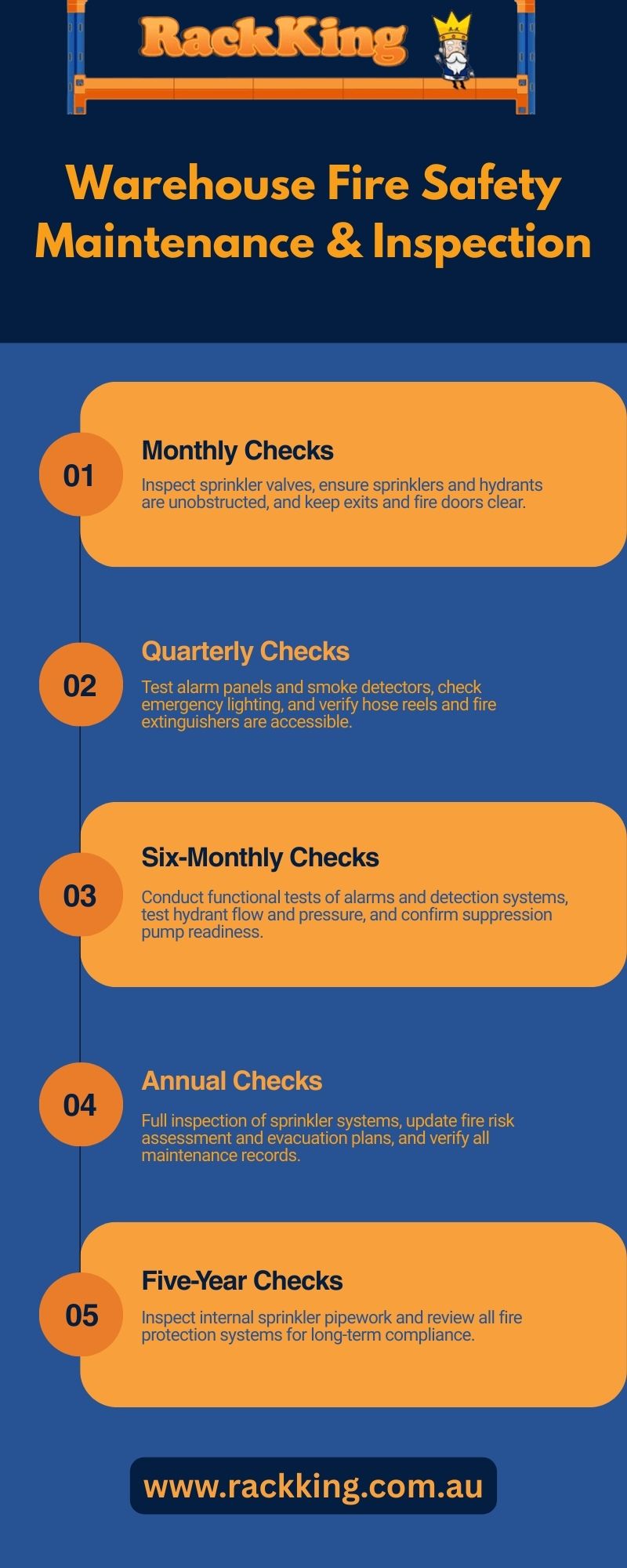
Meeting warehouse fire safety standards is not a one-off certification exercise. Ongoing maintenance is mandatory. AS 1851 sets out routine service intervals for essential fire safety measures.
According to guidance from the Fire Protection Association Australia, routine activities include:
- Monthly sprinkler valve inspections
- Six-monthly alarm testing
- Annual hydrant flow testing
- Five-yearly internal pipe inspections
Failure to maintain warehouse sprinkler systems or warehouse fire alarm systems can result in system impairment, voided insurance and regulatory penalties.
Most states require annual essential fire safety statements, signed by accredited practitioners. Fire authorities such as Fire and Rescue NSW outline documentation requirements for system certification and record keeping. From a WHS perspective, maintaining plants and systems in safe working order is a statutory obligation under model laws from Safe Work Australia.
Warehouse Fire Inspection Checklist: What Inspectors Look For
A warehouse fire inspection checklist helps operators prepare for audits, insurance reviews, and fire authority inspections.
Common inspection focus areas include:
- Clear access to exits, hydrants, and fire panels
- Operational sprinkler valves and unobstructed heads
- Functional alarms and detection devices
- Emergency lighting and exit signage performance
- Up-to-date inspection and maintenance records
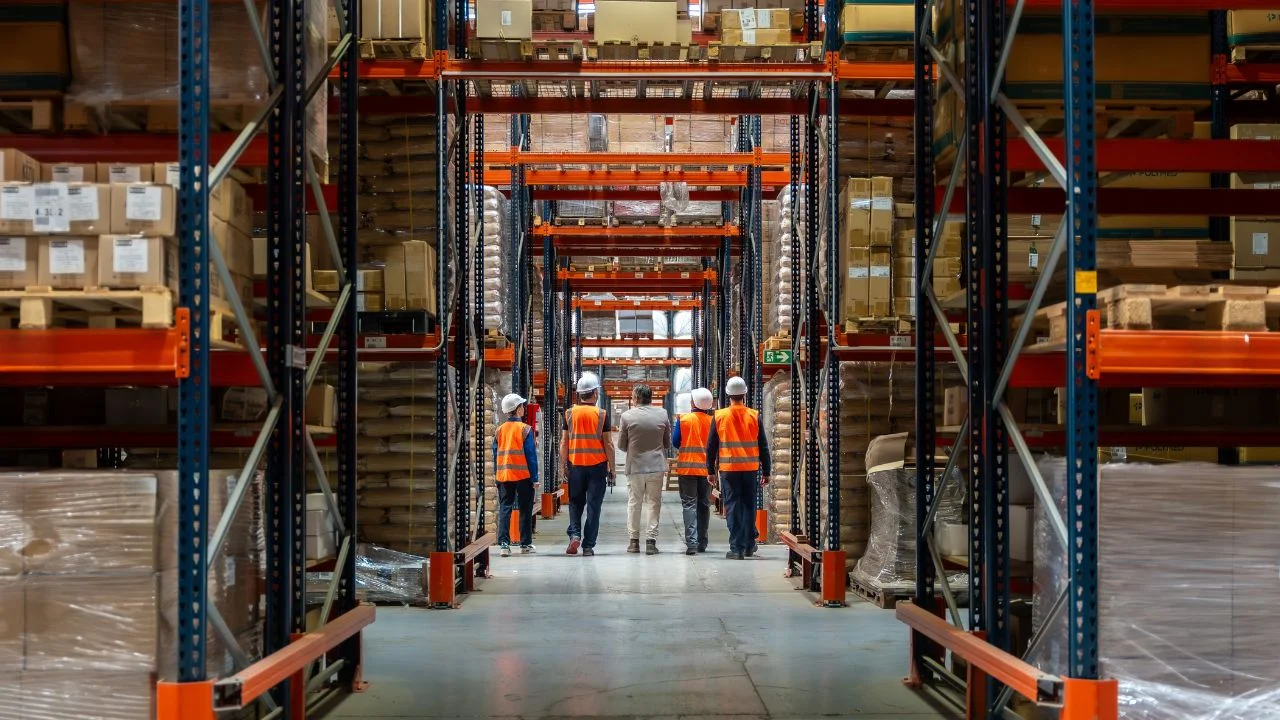
Daily and weekly checks are usually visual and operational, while monthly and annual inspections require certified technicians. State fire authorities note that changes to racking, storage height, or commodities often trigger re-inspection requirements. A structured warehouse inspection can help operators integrate racking safety checks into their broader fire safety audit process.
According to Fire and Rescue Victoria guidance, inspectors also assess housekeeping, ignition source control, and staff training. From a compliance perspective, inspections are not fault-finding exercises but risk controls. Identifying issues early reduces enforcement action and business disruption.
Warehouse Fire Safety Maintenance & Inspection
Common Challenges, Non-Compliance Issues, and Retrofitting Solutions
Older warehouses often face retrofit challenges. Common issues identified in industry guidance from the Fire Protection Association Australia include:
- Inadequate water supply for modern warehouse sprinkler systems
- Storage heights exceeding the original design
- Obstructed hydrant access
- Outdated detection equipment
Planning constraints may limit roof penetrations or tank installation. In these cases, performance-based solutions under the NCC may be considered, subject to fire engineering assessment.
Retrofitting to ESFR sprinkler systems may require ceiling upgrades and revised pipework layouts. While capital-intensive, such upgrades can significantly reduce insurance risk ratings. Operators undergoing major upgrades should also consider warehouse space optimisation as part of a broader improvement program for reconfiguring storage layouts that can simultaneously improve suppression coverage and operational efficiency.
Fire Safety Responsibilities and When to Consult Professionals
Responsibility for warehouse fire compliance depends on ownership and lease structure. Building owners are typically responsible for base building fire systems. Tenants must ensure their operations do not compromise existing protections.
Under model WHS laws from Safe Work Australia, duty holders must eliminate or minimise fire risks so far as reasonably practicable. Racking installations must also comply with AS 4084:2023, Australia’s current standard for steel storage racking, which sets out requirements for design, installation and ongoing inspection that directly support fire safety outcomes by ensuring structural integrity and clearance compliance.
Professional advice should be sought when:
- Increasing storage height
- Changing stored commodities
- Installing new racking
- Upgrading to automated systems
Accredited fire engineers, hydraulic designers and certifiers can interpret warehouse fire safety standards in the context of specific facilities.
Conclusion
Australian warehouses operate within a structured regulatory environment governed by the NCC, Australian Standards and WHS legislation. Effective warehouse fire protection systems, including compliant warehouse sprinkler systems, ESFR sprinkler systems, detection and fire hydrant systems, significantly reduce life safety and financial risk. Compliance is ongoing. Maintenance, documentation and risk assessment are as important as initial installation.
Ensuring your warehouse meets warehouse fire safety standards protects staff, stock, and operations. At Racking Australia, we help you implement and maintain compliant fire protection systems for safer, more secure warehouses.
FAQs
What are the minimum warehouse fire safety requirements in Australia?
Warehouses must meet NCC performance standards for fire resistance, egress, detection, and suppression, including compliant exits, emergency lighting, and, where required, warehouse sprinkler systems and hydrants.
When is an ESFR sprinkler system required?
ESFR systems are needed in high-piled or high-bay storage warehouses where ceiling height, commodity type, and racking increase fire risk. Professional fire engineering advice is recommended.
How often must warehouse fire systems be inspected and maintained?
Inspection and maintenance follow AS 1851 intervals, ranging from monthly to five-yearly depending on system type. Accurate maintenance records are essential for compliance.
Who is responsible for fire safety compliance in a leased warehouse?
Both owners and tenants may share responsibility depending on lease terms and operational control, with duties defined under Safe Work Australia guidance.
What documents prove warehouse fire compliance?
Compliance is demonstrated through fire safety statements, system design certificates, AS 1851 maintenance logs, and inspection/test reports for warehouse fire alarm systems and hydrants.
How do fire safety requirements affect warehouse insurance?
Insurers evaluate fire protection measures; compliant and enhanced fire systems can lower risk ratings and improve coverage terms.