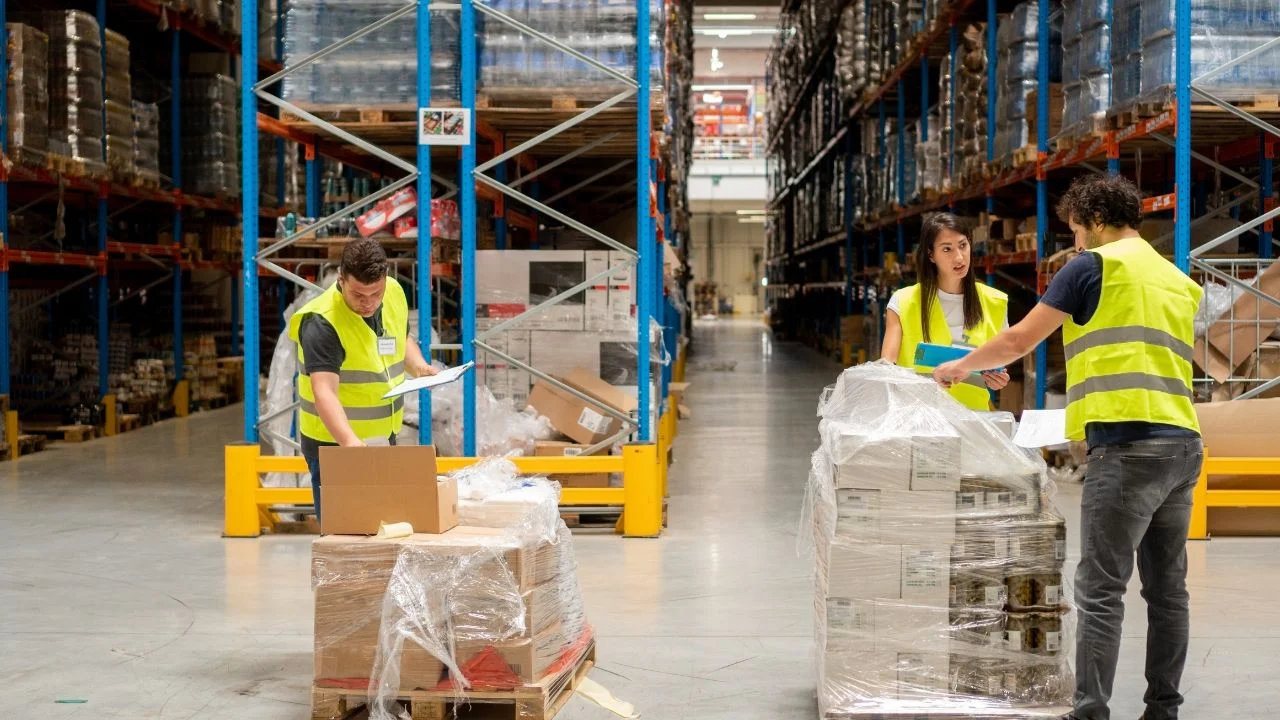
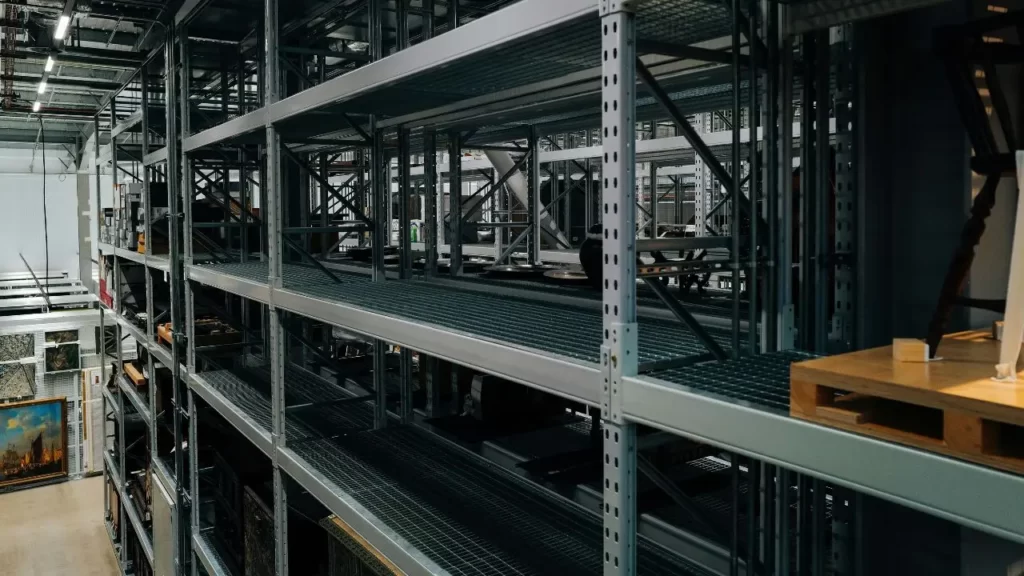
Australian mining warehouses and on‑site storage facilities operate at a scale and intensity few other sectors match. These environments must safely support heavy loads, irregular equipment and high turnover of materials while meeting strict workplace health and safety requirements. Mining racking systems and associated mining storage systems solutions play a central role in enabling efficient workflows, reducing injury risks and ensuring regulatory compliance.
This article is based on extensive research into Australian regulations, industry standards and expert guidance. This guide helps explain what defines these systems, how they differ from general warehouse racks, the standards that apply in Australia, and practical advice for evaluation and purchase.
What Are Mining Racking Systems?
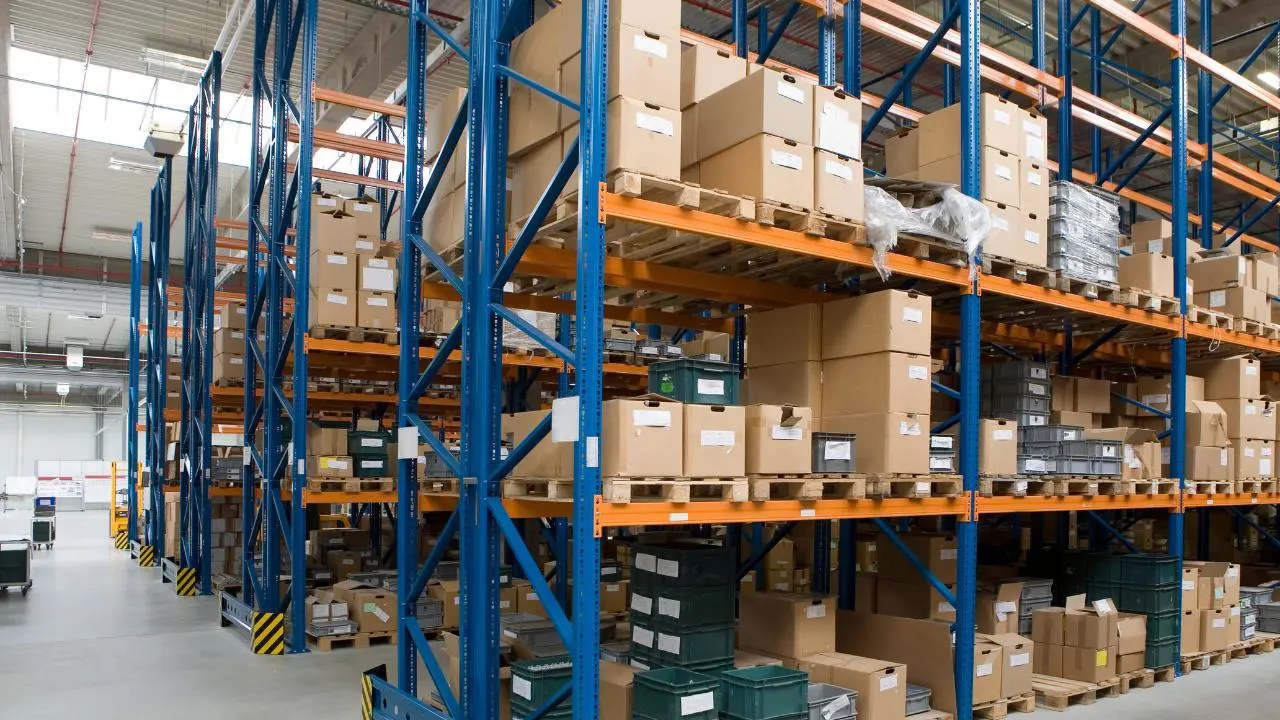
Mining racking systems refer to engineered storage structures designed to hold heavy, irregular and high‑volume loads in mining environments. Unlike generic warehouse shelving, these systems must handle dense palletised goods, oversized spares, tooling and equipment critical to mining operations.
These systems include everything from reinforced pallet racks to specialised mining equipment storage solutions for long materials, drills, hoses and tyres. They are typically installed on purpose‑built warehouses or laydown yards where exposure, dust and frequent handling are everyday conditions.
Off-the-shelf shelving or light industrial racks often fail in mining contexts because they lack:
- Sufficient load capacity
- Impact resistance
- Engineering documentation required to demonstrate safety and compliance
Mining operations demand systems engineered to specification, with documented ratings for static and dynamic loads.
Industrial Mining Racking and Storage Systems in Australia
Heavy Duty Mining Racks
These are reinforced rack systems with high load ratings per beam level, often built from thicker-gauge steel and designed for loads far beyond light or medium duty industrial racking. According to AS 4084 2023 guidelines, rack design must account for both static loads and impact loads from material handling equipment.
In Australia, heavy duty systems are:
- Engineered to comply with steel storage standard
- Used where loads regularly exceed several tonnes per level
Australian suppliers show these racks are built to withstand extreme conditions typical of mining logistics zones.
Mining Equipment Storage Solutions
Effective mining equipment storage solutions accommodate diverse item types. These include:
- Cantilever racks for long pipes, hoses, and structural steel
- Tyre racks for large off-highway vehicle tyres
- Shelving for tooling and smaller spare parts
- Modular systems adaptable to fluctuating inventory
WorkSafe Queensland highlights the importance of secure load restraint to prevent roll-offs or shifting materials. In mining environments, irregular shapes increase risk, making tailored mining storage systems preferable over generic shelving. Flexibility is essential as mining inventories change with project phases.
Mining Warehouse Storage Systems
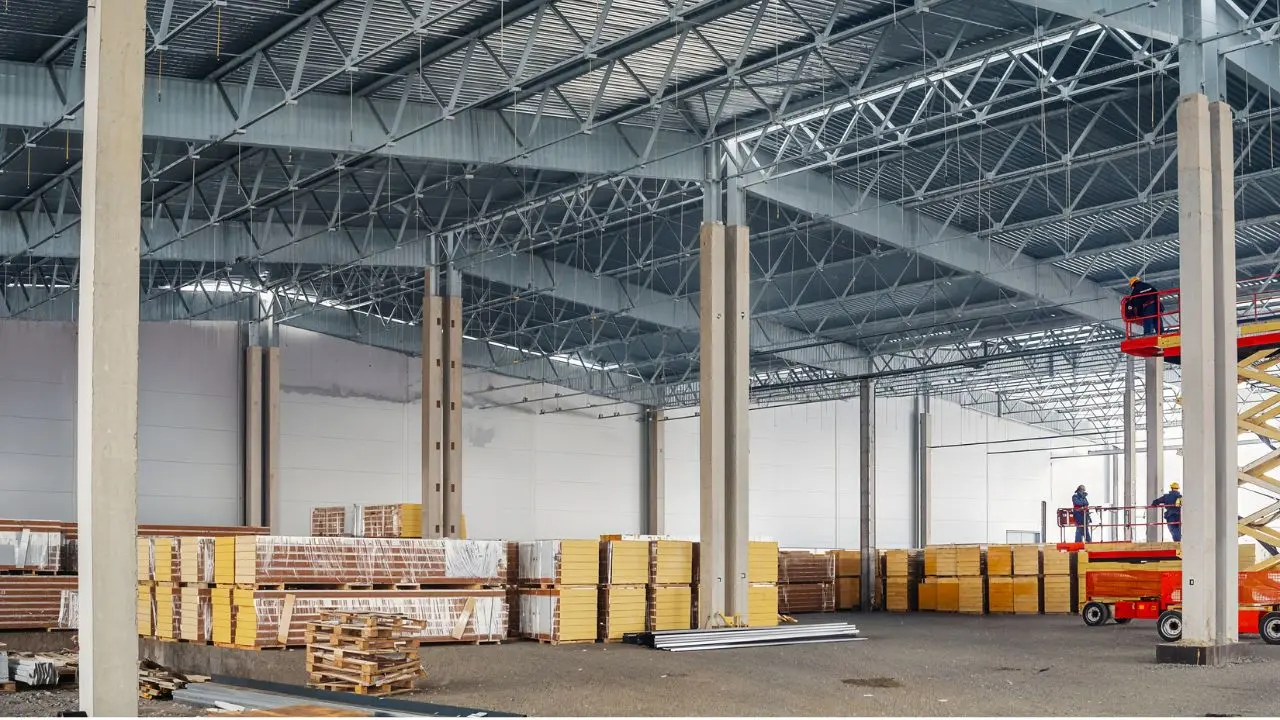
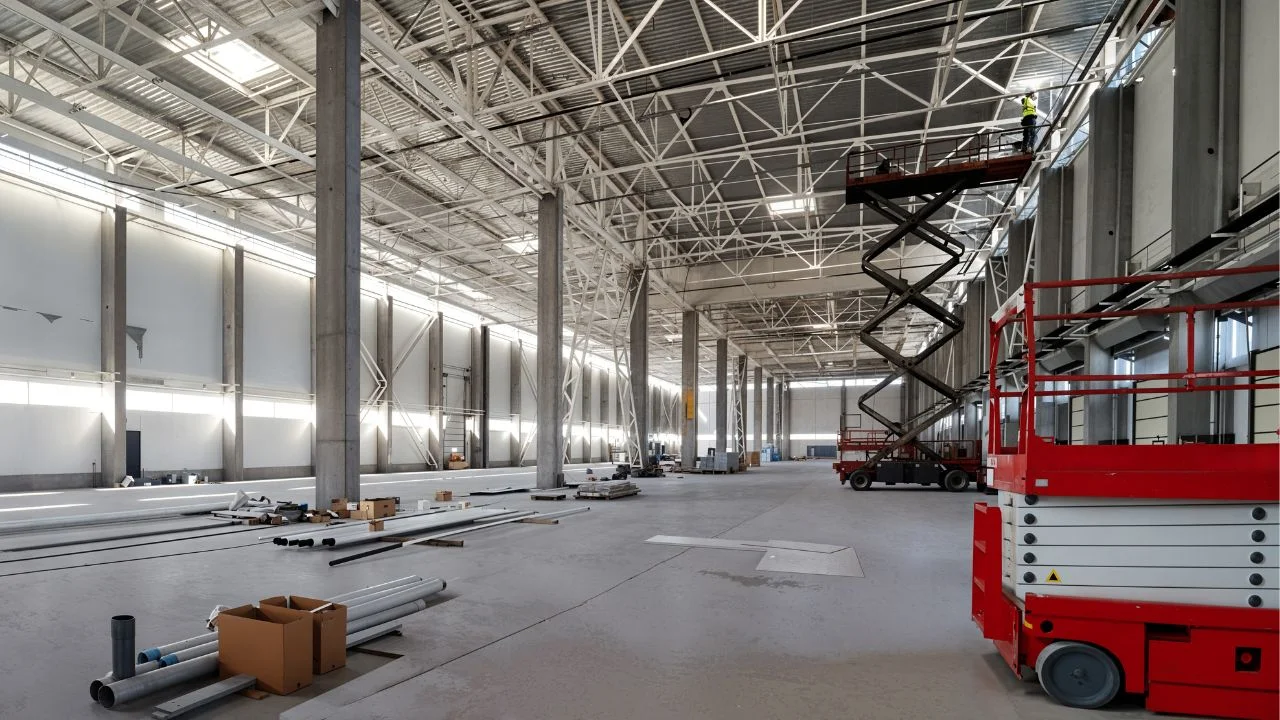
Mining warehouse storage systems can be configured as high-bay or low-bay installations depending on site constraints and floor loading capacity. According to WorkSafe Australia, slab load ratings and anchoring integrity are fundamental when designing high-load racking.
While Australia is not generally classified as high seismic risk, certain regions require consideration of lateral stability. Proper anchoring and structural bracing improve performance under vibration and operational impact.
Industrial Mining Racks vs General Warehouse Racking
Standard warehouse pallet racking offers structural support for many goods, but industrial mining racks are designed for far more demanding environments. Australian mining operations place exceptional stress on storage systems due to heavy loads, irregular equipment, frequent handling, and higher safety risks.
According to SafeWork NSW, pallet racking used in industrial and mining settings must meet specific criteria covering structural integrity, load tolerances, and inspection regimes that go well beyond generic shelving guidance.
| Feature | Industrial Mining Racks | General Warehouse Racking |
| Typical Load Capacity | Engineered for very high loads, often several tonnes per beam level | Designed for moderate palletised loads |
| Steel Specification | Thicker-gauge steel with higher safety margins | Lighter steel profiles suitable for standard goods |
| Design Standard Alignment | Engineered to meet AS 4084 design and operational requirements | Often supplied without site-specific engineering |
| Durability in Harsh Environments | Built to withstand dust, vibration, and frequent impact | Limited tolerance for harsh industrial conditions |
| Inspection & Maintenance Requirements | Formal inspection regimes and documented load signage | Basic inspection practices, often informal |
| Failure Risk Under Mining Loads | Significantly reduced when properly engineered and maintained | Higher risk if used beyond intended capacity |
| Lifecycle Cost | Higher upfront cost but lower long-term downtime and replacement | Lower upfront cost but higher failure and maintenance risk |
From a lifecycle perspective, this difference is critical. Robust, engineered mining racking systems reduce downtime, minimise repair frequency, and lower the risk of catastrophic failures that can halt operations or trigger regulatory scrutiny. For mining facilities, the long-term operational and safety benefits typically outweigh the initial cost difference compared to repurposing general-purpose warehouse racking.
Mining Material Handling Systems and Workflow Efficiency
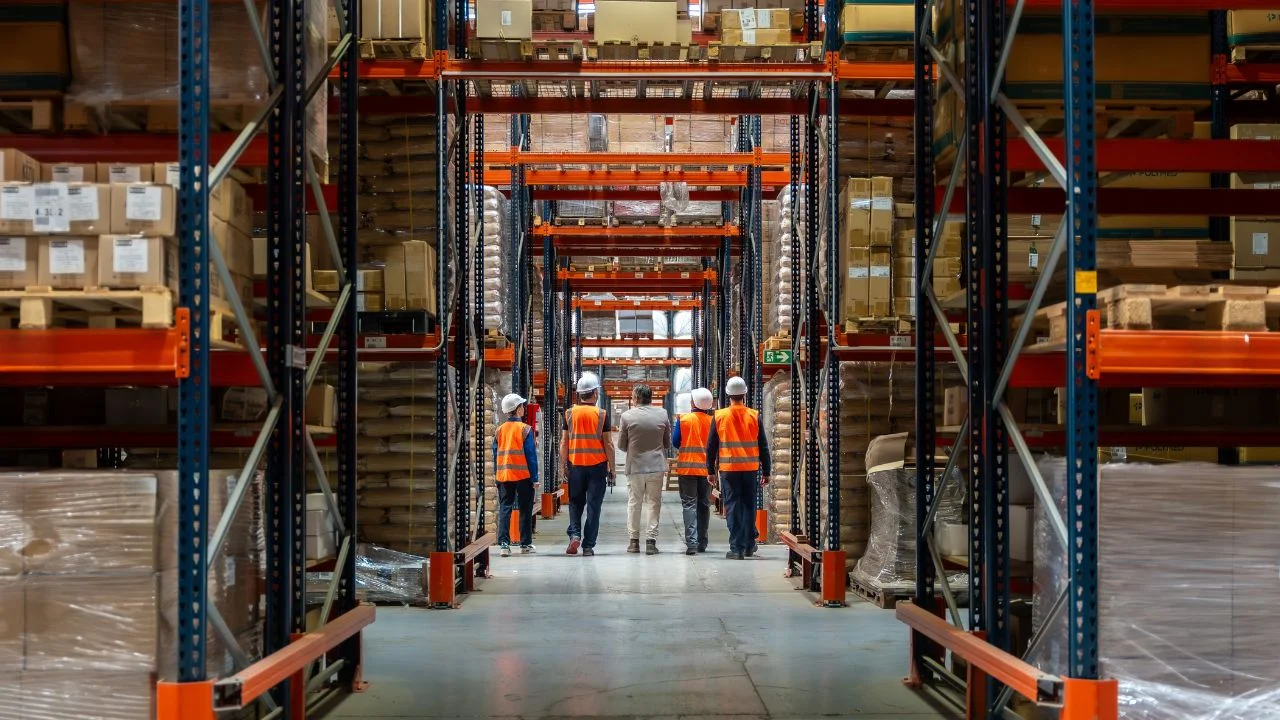
Storage cannot be evaluated independently from mining material handling systems. Racking layout directly affects material flow, forklift travel distance, congestion points, and operator visibility.
According to Safe Work Australia on managing risks of plants in the workplace, collisions between forklifts and storage structures are a common hazard in industrial environments. Poorly designed layouts increase turning movements, reversing frequency, and blind intersections.
Integrated systems typically involve:
- Forklifts and reach trucks
- Overhead cranes
- Pallet movers
- Loading docks
- Designated pedestrian exclusion zones
WorkSafe Victoria emphasises that effective traffic management planning reduces incident rates and improves workflow continuity. Design mining racking systems in line with handling equipment specifications to reduce obstructions and lower collision risks for operators.
Mining Workplace Safety Solutions: Compliance and Risk Reduction
Mining warehouses involve heavy loads, forklift traffic, and high-bay storage. Poorly designed mining racking systems increase the risk of collapse, falling objects, and vehicle impact.
Under Australian WHS laws, operators must manage risks linked to storage infrastructure. The benchmark standard is AS 4084:2023, issued by Standards Australia. While not legislation, it is widely used to demonstrate compliance.
Well-designed mining workplace safety solutions typically include:
- Engineered load ratings with documented calculations
- Load limit signage on every bay
- Anchored uprights and structural bracing
- Mesh backing in pedestrian areas
- Impact protection barriers
AS 4084 Part 2 recommends regular visual warehouse inspections and periodic professional assessments. Increase inspection frequency in high-impact mining environments. Effective mining storage systems combine compliant racking with operational controls to ensure optimal performance. That combination reduces injury risk, protects inventory, and supports regulatory compliance.
Australian Standards and Regulations Affecting Mining Storage Systems
The key technical reference in Australia is the Australian Standard AS 4084 series for steel storage racking. The current framework is split into:
- AS 4084.1:2023 (design)
- AS 4084.2:2023 (operation and maintenance)
These standards cover design tolerances, load ratings, inspection regimes, anchoring and documentation. While AS 4084 doesn’t itself carry the force of law, it is widely used to demonstrate compliance with Work Health and Safety laws. Regulators and insurers commonly reference AS 4084 when assessing risk and compliance during audits.
Maintaining compliant systems in mining facilities requires:
- Regular inspection by a competent person
- Documentation of load limits
- Maintenance records
How to Evaluate Mining Racking Systems Before Purchase
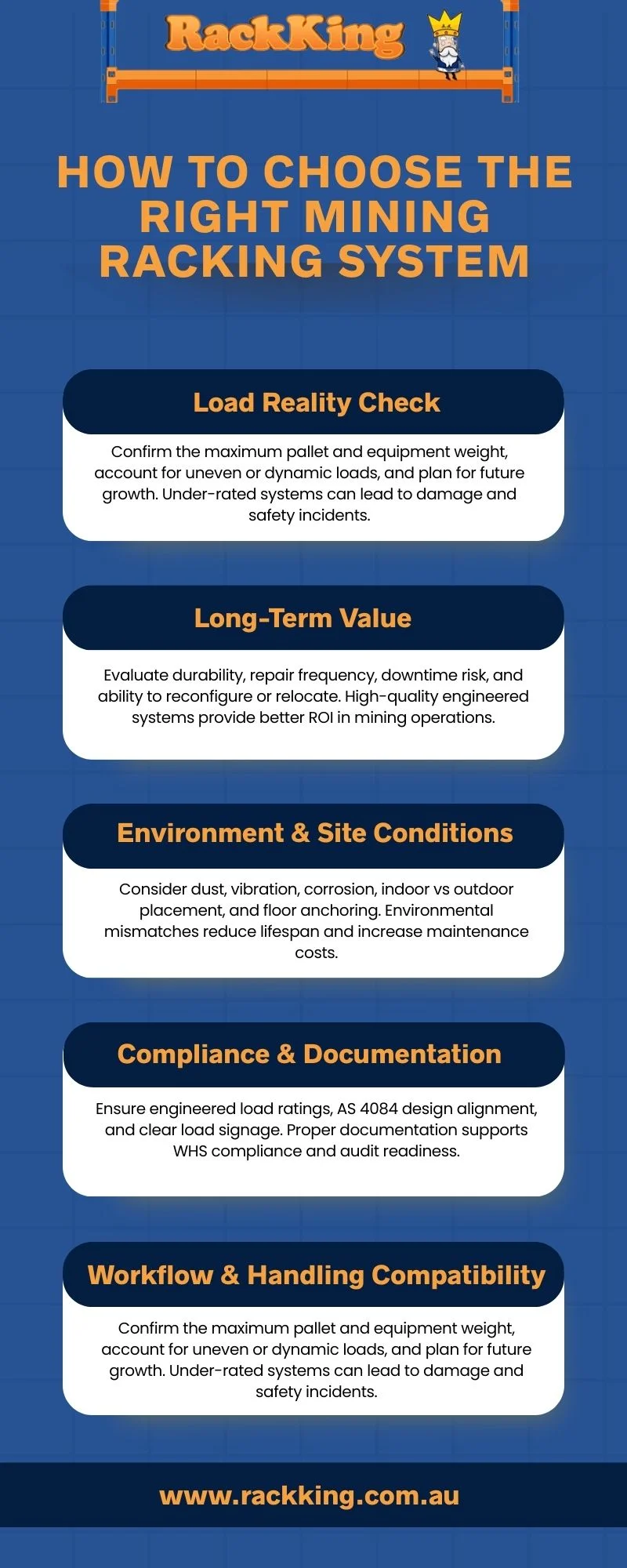
Assessing mining racking systems begins with understanding load requirements and future growth plans. Accurate load assessment prevents racks from being over- or under-specified. Environmental factors such as dust, corrosion, and vibration guide material selection and protective coating choices.
Supplier documentation is critical and should include:
- Engineering drawings
- Load tables
- Certificate of compliance with AS 4084 (or equivalent engineered design)
These provide evidence that the system meets performance and safety benchmarks.
How to Choose the Right Mining Racking System
Cost Factors, Installation, and ROI for Mining Racks
The cost of heavy-duty mining racks depends primarily on:
- Steel grade and thickness
- Load rating requirements
- Site preparation and slab capacity
- Compliance documentation and engineering
Installation timelines vary based on warehouse size and configuration complexity. Anchoring and alignment must meet AS 4084 tolerances. Australian workplace regulators indicate that plant-related incidents can result in significant downtime and investigation costs. Investing in compliant warehouse storage systems reduces the probability of structural failure and load displacement.
Custom systems may command premium pricing but are justified where standard racks cannot safely accommodate loads. Long-term ROI improves through durability, reduced repair frequency, and fewer operational disruptions.
Limitations, Challenges, and When Professional Advice Is Required
No single racking solution fits all mining operations. Variables include:
- Outdoor exposure
- Relocation requirements
- Site geometry
Research helps frame needs, but only on-site professionals can validate:
- Soil conditions
- Floor capacity
- Handling equipment interactions
Hiring qualified engineers for warehouse layout and inspection is necessary to mitigate risks that research alone can’t fully address.
Conclusion
Selecting the right mining racking systems is not just a storage decision. It directly affects safety outcomes, workflow efficiency, compliance exposure, and long-term operating costs. Australian standards, WHS guidance, and industry commentary consistently show that mining environments place demands on storage systems that exceed general warehousing assumptions. Heavy loads, irregular equipment, harsh conditions, and constant handling mean engineered, compliant solutions are essential rather than optional.
If you are evaluating or upgrading mining storage solutions, Racking Australia can assist with engineered, AS 4084-aligned racking systems designed for Australian mining environments. Speaking with an experienced supplier early can help reduce risk, improve ROI, and ensure your facility remains safe, compliant, and operational as demands grow.
FAQs
What load ratings are typical for heavy-duty mining racks in Australia?
Mining racking systems designed for heavy-duty use often have load ratings well above standard warehouse racks, regularly in the multiple tonnes per beam level range. Australian suppliers cite engineered capacity design compliant with AS 4084 and backed by structural analysis to achieve these ratings.
Are mining racking systems legally required to meet Australian Standards?
Standards such as AS 4084 are not laws, but WHS regulators regularly reference them as benchmarks for compliant design and operation. Demonstrating adherence to these standards helps meet legal obligations.
Can standard pallet racking be used in mining warehouses?
Standard pallet racks suit low-stress environments, but research and safety guidance advise against using non-mining-grade systems for the extreme loads common in mining without engineering assessment and certification.
How do mining material handling systems affect warehouse safety?
Poor coordination between racks and handling equipment increases the risk of collisions, load displacement and structural damage. Systems designed with clear aisle widths and machine compatibility reduce these risks and improve throughput.
Who is responsible for ensuring racking compliance in mining facilities?
Regulatory guidance consistently states that facility operators are responsible for ensuring that storage systems and their maintenance meet WHS obligations and applicable standards.
Can racks be used outdoors or relocated?
Weather‑resistant treatments and galvanising allow some mining warehouse storage systems to be used outdoors. Modular designs support relocation, but each new site requires re‑assessment and, if necessary, re‑engineering to maintain compliance.