
For Australian warehouse owners and operations managers, understanding warehouse storage capacity is crucial. It determines how much stock a facility can safely store without affecting efficiency, safety, or compliance. Optimising capacity reduces cost per pallet stored, improves labour productivity, and supports better service levels. Accurate warehouse space calculation prevents under‑utilised zones, bottlenecks, and unnecessary operating costs. This guide explains warehouse capacity formulas, measurement techniques, planning strategies, and modern tools that enhance storage efficiency and warehouse operations.
What is Warehouse Storage Capacity?
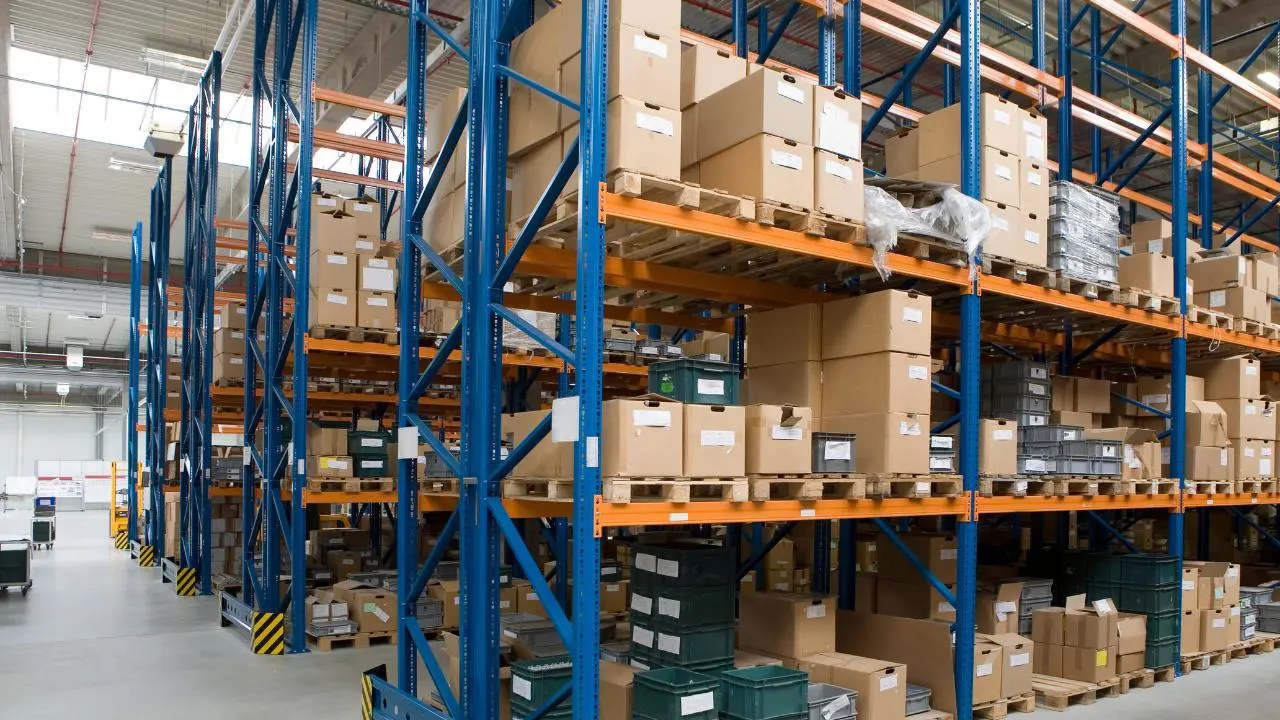
Warehouse storage capacity is the maximum amount of inventory that a facility can safely and efficiently hold. It goes beyond simply measuring the building’s physical volume and considers how space is used for storage, movement, and operations. Understanding this capacity is essential for Australian warehouse owners and managers to optimise cost, workflow, and safety.
Effective capacity planning accounts for factors such as pallet density, stacking height, and available floor area, while also recognising operational constraints like aisles, staging zones, and safety clearances. According to Australia’s National Freight and Supply Chain Strategy, improving efficiency across warehousing and logistics is a key priority for national productivity, highlighting that operational constraints like layout, workflow, and space utilisation must be factored into capacity planning to avoid overestimation of real storage capability.
Types of Capacity:
- Physical Capacity: Total geometric space of the facility minus structural or regulatory constraints.
- Operational (Usable) Capacity: Real-world space after accounting for aisles, packing zones, staging areas, and safety clearances. Usable capacity is often 10–20% less than gross capacity.
Key Factors Affecting Warehouse Storage Capacity
Proper capacity planning integrates building constraints, equipment needs, and operational workflows to avoid congestion and overestimation of space.
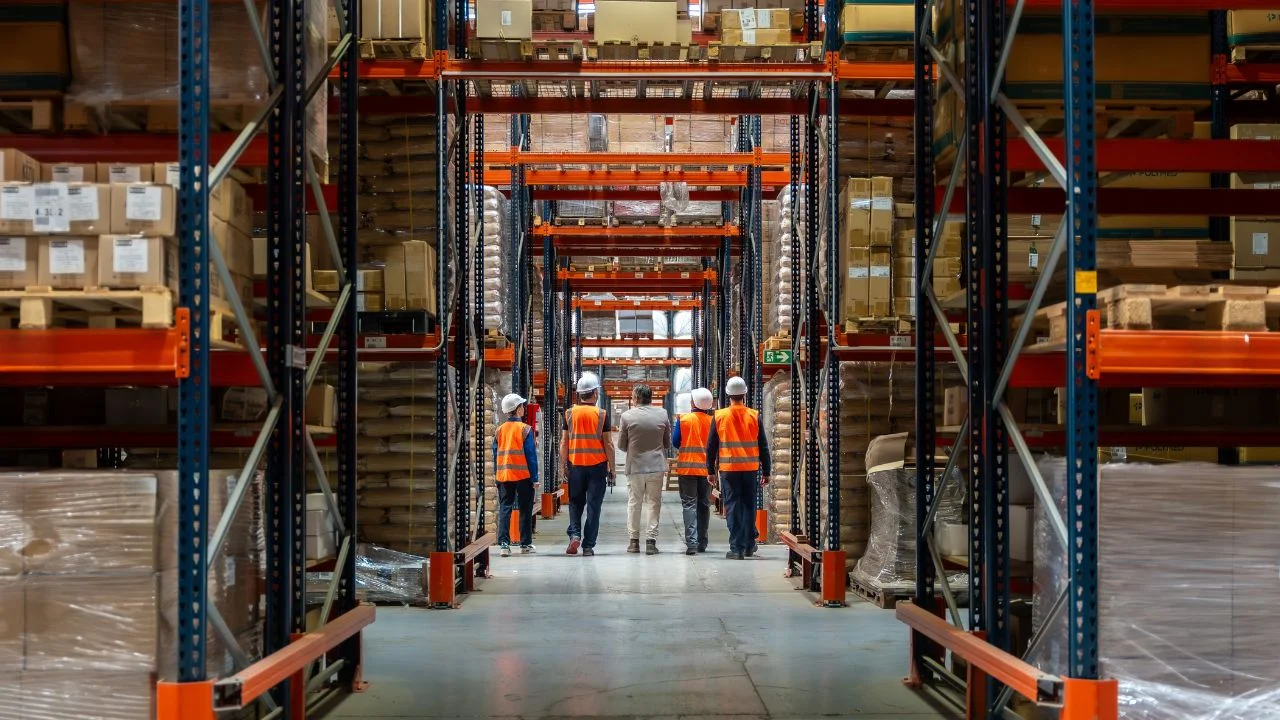
- Layout and aisle design: Narrow aisles increase storage density but require specialised equipment. A well-planned warehouse layout design is fundamental to balancing
- Racking and shelving systems: Higher, adjustable racks improve capacity but may require engineering approval under Australian standards. Understanding different warehouse racking types helps managers choose the right system for their inventory profile.
- Inventory mix: Large or irregular items reduce stacking efficiency and lower overall capacity.
- Safety and access zones: Safe Work Australia requires minimum aisle and access widths to protect staff.
Understanding Warehouse Capacity Formulas
Structured formulas help move beyond guesswork to measure real storage capacity.
Basic Pallet-Based Formula:
Pallet Capacity = (Net Storage Area ÷ Pallet Footprint) × Levels × Efficiency Factor
- Net Storage Area: Total floor area available after aisles, offices, and staging zones.
- Pallet Footprint: Standard Australian pallet ~1165 mm × 1165 mm.
- Levels: Number of safe vertical racking levels.
- Efficiency Factor: Operational adjustment (0.8–0.9) for aisles, handling, and safety.
Example:
A 5,000 m² warehouse with 1,000 m² for aisles:
Usable space = 4,000 m²
Pallet footprint = 1.36 m²
Storage levels = 4
Efficiency = 0.85
Capacity = (4,000 ÷ 1.36) × 4 × 0.85 ≈ 10,000 pallets
For bulk or irregular items, calculate in cubic metres:
Capacity (m³) = Usable Volume × Stackability Factor
Stackability depends on product type and compliance with Australian standards like AS 4084 2023.
Common Mistakes: ignoring clear height, assuming perfect stacking, or overlooking dead zones like corners or near exits.
Manual Warehouse Space Measurement
Accurate warehouse space calculation is essential for effective warehouse capacity planning. Manual measurement provides the baseline data needed to understand your facility’s usable storage area and ensure compliance with Australian standards.
Surveyors and warehouse professionals typically assess:
- Usable floor area after subtracting offices, staging zones, and aisles
- Clear height available for stacking inventory
- Aisle widths required for safe operation of equipment
- Obstructions such as columns, doors, or fixtures
While these methods are reliable for initial assessments, manual calculations can be time-consuming and prone to errors in complex or large-scale warehouses. Proper measurement ensures planners understand the real capacity available for storage and operational workflows.
Digital Tools for Warehouse Space Calculation
Australian warehouses increasingly leverage digital solutions to improve accuracy and efficiency in warehouse space calculation.
Warehouse Management Systems (WMS)
A WMS tracks inventory locations, monitors turnover, and provides real-time data on storage utilisation. It helps identify underused areas and optimises slotting for peak demand periods. Pairing a WMS with the right warehouse operational tools further streamlines day-to-day workflows and reduces manual handling errors.
Mapping and CAD Tools
Software like AutoCAD or logistics-specific design platforms allows detailed modelling of warehouse layouts, precise capacity calculations, and simulation of alternative configurations. These tools integrate layout, racking, and workflow considerations, providing realistic planning insights.
Benefits of Digital Tools
- Higher accuracy: Reduces human error in measurements.
- Scenario planning: Simulate layouts without physical rework.
- Real-time utilisation monitoring: Track occupancy and inform operational decisions.
Industry reports show that warehouses using digital tools often improve space utilisation by 10–20% compared to manual-only methods.
Choosing the Right Tool
- Small facilities: Spreadsheets and simple CAD designs may suffice.
- Medium to large warehouses: Integrated WMS linked with ERP systems provides significant gains.
- Complex operations: Volumetric modelling within CAD or specialised software ensures accurate capacity estimation for irregular or high-SKU storage.
Combining accurate measurements with the right digital tools allows Australian warehouses to optimise warehouse storage capacity, reduce operational bottlenecks, and improve workflow efficiency, all while maintaining compliance with safety and racking standards.
Warehouse Capacity Planning Strategies
- Slotting and Layout Optimisation: Position high-demand items for easy access and smooth flow.
- Forecast-Based Space Allocation: Allocate space using historical data and demand projections to prevent overcrowding.
- Inventory-Driven Adjustments: Prioritise fast-moving stock in accessible zones.
- Process Integration: Coordinate storage, picking, and replenishment to maximise efficiency.
Following structured guidelines improves space utilisation, workflow efficiency, and compliance with Australian standards without costly expansion.
Inventory Management’s Role in Capacity Optimization
Proper inventory control directly impacts capacity:
- Demand forecasting: Anticipating inventory requirements prevents excess stock from occupying valuable space.
- Stock classification: Categorising items by turnover (fast, medium, slow-moving) allows planners to allocate space appropriately.
- FIFO/LIFO application: Proper rotation methods minimise spoilage and free up storage for high-demand items. SafeWork NSW recommends regular reviews of risk controls and workflows to ensure they continue to manage risks effectively.
- Regular audits: Cycle counting and WMS data verification maintain accurate inventory records, enabling better space utilisation.
Using WMS and analytics improves accuracy, lowers safety stock, and balances service levels with space utilisation.
Warehouse Management Solutions to Maximise Capacity
Technology and infrastructure play a crucial role in improving warehouse storage capacity by increasing density, reducing handling time, and supporting efficient warehouse operations.
Automated Storage & Retrieval Systems (ASRS)
- Maximises vertical space and reduces aisle width.
- Speeds picking and replenishment, suitable for high-density operations.
Modern Racking Solutions
- Pallet flow, push-back, selective racking increase density.
- Compliance with Australian engineering and safety standards is essential.
Different racking solutions offering scalability and better space density
Facility Size Considerations
- Small warehouses: basic racking + manual picking.
- Medium warehouses: selective automation + WMS.
- Large warehouses: full automation with ASRS for maximum throughput.
When implementing these solutions, Australian warehouse managers should account for SKU variety, stacking limits, equipment requirements, and operational workflows. Professional guidance and compliance with safety regulations ensure that capacity gains do not compromise staff safety or operational efficiency.
By integrating appropriate automation and racking systems, warehouses can significantly increase warehouse storage capacity, streamline operations, and improve overall space utilisation.
Optimizing Operations and Layout for Space Efficiency
Maximising warehouse storage capacity depends not only on technology and racking but also on how operations and layouts are structured. Efficient design reduces travel time, improves picking accuracy, and ensures safe workflows.
Layout Improvements
- Narrow aisles with specialised equipment.
- Full vertical utilisation and mezzanine platforms.
Adding a multi-level mezzanine is one of the most effective ways to double usable floor space without expanding the building.
Operational Enhancements
- Cross-docking to reduce storage demand.
- Zone picking and staging buffers to streamline flow.
Safety & Compliance
Australian standards mandate clear access routes, emergency egress, and minimum aisle widths. WHS laws require all businesses to ensure, so far as is reasonably practicable, the health and safety of workers in the warehouse environment. Properly planned layouts consider these requirements to maintain operational efficiency without compromising staff safety.
By combining strategic layout adjustments with workflow improvements, Australian warehouses can enhance storage density, streamline warehouse operations, and make the most of available space while staying compliant with safety regulations.
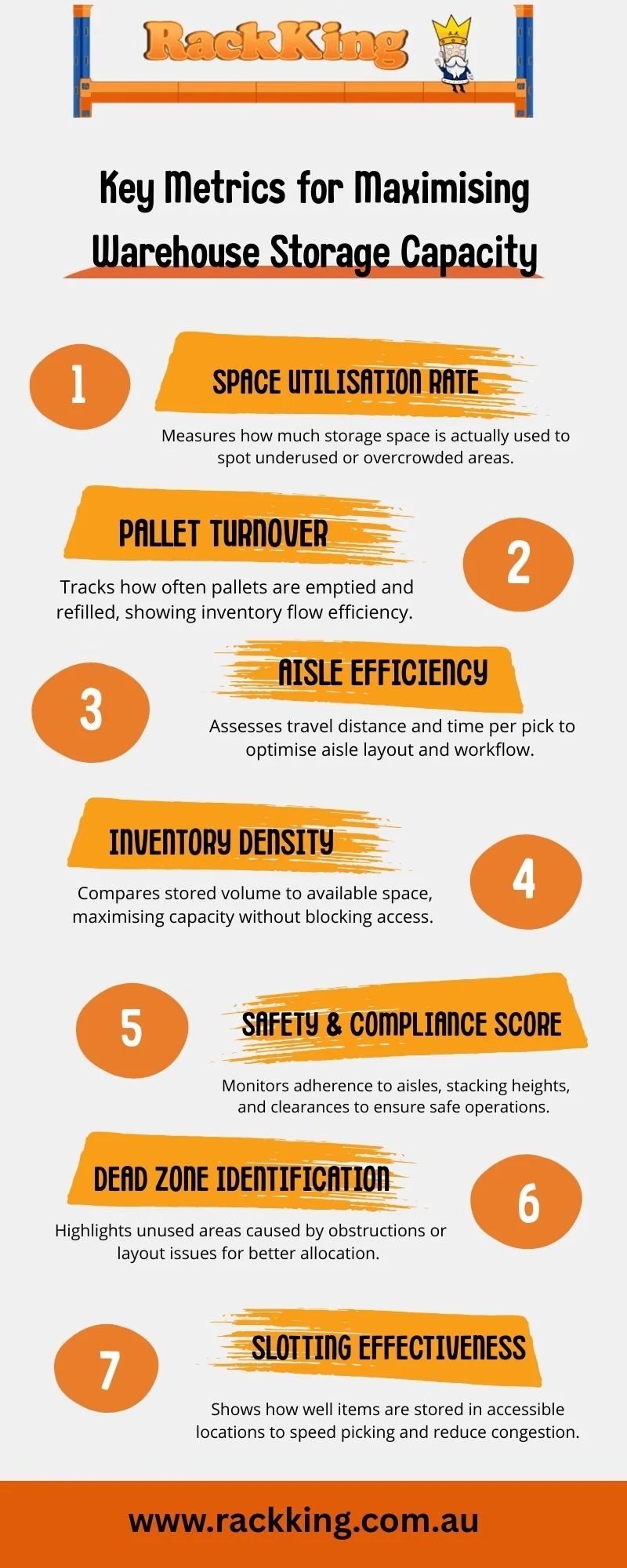
Key Metrics for Maximising Warehouse Storage Capacity
Common Challenges and Solutions
Australian warehouses often face capacity limitations not because of building size, but due to operational inefficiencies and compliance constraints. Addressing these issues systematically can significantly improve warehouse storage capacity without physical expansion.
| Challenge | Solution |
| Overcrowding | Improve slotting accuracy, strengthen demand forecasting, and reduce excess safety stock. |
| Regulatory constraints | Engage qualified safety assessors to design compliant layouts aligned with Australian standards. |
| Equipment interference | Use narrow aisle trucks or introduce mechanised picking to reduce required aisle widths. |
| Inventory inaccuracy | Implement regular cycle counting and strengthen inventory controls within your warehouse management solution. |
Conclusion
Optimising warehouse storage capacity is essential for efficiency, safety, and cost management in Australian warehouses. Accurate calculations, capacity planning, inventory control, and modern warehouse management solutions unlock space and streamline operations. Combining technology, workflow design, and compliance with Australian standards allows warehouses to maximise storage without expanding facilities. Regular assessment, smart layout, and informed technology investment ensure long-term operational efficiency and scalability.
Ready to optimise your warehouse space? Visit RackKing to explore expert racking solutions and smart storage systems tailored for your facility.
FAQs
How do I calculate usable warehouse space?
Measure the net storage area after subtracting aisles, offices, staging zones, and safety clearances. Combine this with rack levels and an efficiency factor to estimate capacity.
How can I increase storage without expanding the warehouse?
Optimise slotting for high-turnover items, use vertical racking, consider mezzanine platforms, and implement narrow-aisle designs with appropriate equipment.
What role does inventory management play in capacity optimisation?
Good inventory control, such as ABC classification, FIFO/FEFO rotation, and demand forecasting, ensures space isn’t wasted on slow-moving stock and improves storage efficiency.
Which technologies help maximise warehouse capacity?
Warehouse Management Systems (WMS) track utilisation and inventory in real time, while Automated Storage and Retrieval Systems (ASRS) and modern racking solutions boost density and operational efficiency.
How often should warehouse layouts and capacity plans be reviewed?
Quarterly or after major inventory or seasonal changes. Regular reviews prevent congestion, improve workflow, and ensure compliance with Australian safety standards.