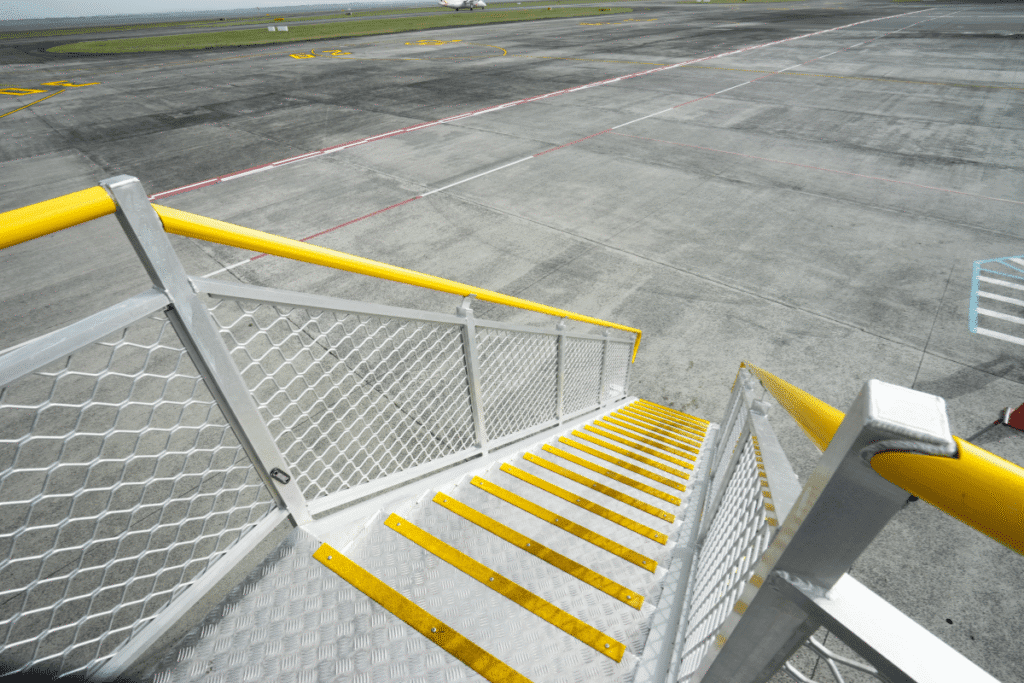
In warehouses, factories, and commercial buildings, stairs play a crucial role in helping people navigate safely between levels. These stairs are much more than a collection of steps. They’re an essential part of how a space functions every day. When stairs are built without following safety rules, there is a high risk of injury and accidents. In Australia, compliance and safety are not just a matter of choice. They are also a requirement.
BCA Compliant Stairs comply with Australian Standards, providing strength, stability, and protection to every user. These stairs are built to last. They meet the exact requirements set by Australia’s Building Code.
Rackking & Sydney Steel Stairs provide BCA-compliant stairs in Australia to businesses in need of reliable solutions. The stair systems they deliver combine safety, durability & design excellence.
What Does “BCA Compliant Stairs” Mean?
BCA Compliant Stairs comply with the Building Code of Australia’s (BCA) safety, construction, and design standards. This code is an Australian national guideline that governs the construction and design of buildings for public safety. It details the exact measurements, materials, and features required to ensure that stairs are safe and comfortable.
BCA compliance means that the stair has been tested according to strict standards for building, ensuring every riser or tread, as well as any balustrade, meets legal requirements. These standard stairways are not designed just to look nice; they’re also built to help people move, reduce slipping hazards, and avoid workplace injuries.
According to the Australian standards, stairways reflect an organization’s commitment to safety and responsibility. This ensures the safety of both employees and visitors. BCA Compliant Stairs, in short, are a promise for safety, function, trust, and reliability within any industrial, commercial, or institutional setting.
The Key Australian Standards For Stairs
In Australia, strict safety rules are followed in the design and construction of stairs to protect their users. These rules are part and parcel of the Australian standards that govern stairs in Australia. They form the basis for safe design in Australia. The National Construction Code is the main standard, followed by AS1657-2018 and AS1428.1. All three standards guarantee that stairways are designed and built safely, regardless of the size or purpose.
BCA Part 3.9.1 National Construction Code
The NCC lays out the basic rules for all standard staircases in buildings. It emphasizes safety features, such as measurements, that will keep users steady while walking.
- Riser Height: 115mm to 190mm.
- Tread depth going: between 240 mm to 355mm.
- Slope formula: Must follow the rule of 2R+G=550 mm to 700 mm.
- Uniformity. Each step has to be the same size.
- Solid treads – Required on balustrade stairs above 10m high or connecting three stories.
- Openings: No gaps big enough to fit a round 125mm in.
All users will feel more confident and comfortable if they follow these tips.
AS1657-2018: Fixed Platforms, Walkways and Stairs
This standard is applicable to all industrial and mezzanine stairways under 200m2. It is important to maintain workplace safety and strength.
- Handrails on both sides of the stairs that are larger than 1000 mm.
- Balustrade stairs must have a height of at least one meter
- Slip Resistance must comply with AS 4586 Safety Level.
- Rail gaps should not exceed 460mm.
- Maximum number of risers per flight: 18.
These guidelines will help you to avoid falls in industrial areas and keep your workplace safe.
AS1428.1 Accessibility Standard
This standard is designed for large public areas or mezzanines larger than 200 m2. It ensures that all users are included in the design of stairs.
- Minimum 1 meter clear width between handrails.
- Continuous balustrades – from the ground to the mezzanine.
- A tactile indicator is placed at both the top and lower steps of the staircase for those who are visually impaired.
- Openings: No sphere larger than 125mm can pass through.
Together, the standards will ensure that all Australian stairways meet the highest level of safety, strength, and access.
Material And Design Requirements
The materials and designs used in stair design determine the durability and safety of a stair. Steel construction is essential in industrial and warehouse buildings because of its strength, fire resistance, and low maintenance. Steel also allows for precise shape and alignment.
Some types of stairs are permitted, depending on the type of structure
- Use the alternate tread stairs when space is at a premium.
- Spiral staircases have been approved for specific areas where space-saving is needed.
- Ship ladders are not permitted under any conditions of construction because they are unsafe and unsuitable for regular use.
In order to increase safety and comfort in the workplace, there are certain design principles that must be followed.
- Handrail Height – Between 900 and 1100mm
- Grip Size: A secure grip is between 30mm and 65mm.
- Balustrades on stairs: They must be at least one meter tall with an even spacing between the rails.
These features combine strength and safety while maintaining the appearance of modernity and cleanliness. Proper stair design in Australia is more than just meeting Australian standards. It’s about long-term performance, comfort, and visual appeal. Each detail of the design is intended to promote a safer, more comfortable movement for all users.
Why Does BCA Compliance Matter?
The Building Code of Australia is a responsibility that extends beyond the legal realm. BCA Compliant Stairs prevent slips and falls as well as serious injuries due to unsafe construction. The results of a stair system’s failure to meet safety requirements can be detrimental in many different ways.
Non-compliance will lead to the following:
- Penalties and fines for the authorities.
- Rejection of insurance claims during accident investigation.
- Construction or removal costs of stairs that are not compliant.
- Workplace accidents that harm both employees and visitors.
Compliance ensures stairs are built to last, meet safety and legal standards, and comply with design. BCA Compliant Stairs Australia provides peace of mind to property owners that their building complies with the BCA Compliant Stairs Australia standards.
Rackking will ensure that any stair system it installs or designs meets or exceeds all national standards. By choosing compliant stairs, businesses are protecting lives, preventing legal trouble, and showing a true commitment to professionalism and safety.
What To Know About Indoor Vs. Outdoor Stairs?
Both indoor and outdoor stairs play an important part in connecting spaces safely. They are designed differently, have different materials, and are more durable. Indoor stairs concentrate on style, comfort, and space-efficiency, while other need to handle temperature and moisture changes as well as weather conditions.
Outdoor designs must be constructed with stronger materials that are resistant to corrosion, like stainless steel and galvanized metal. They need:
- Slip-resistant surfaces are essential to avoid accidents when it is raining or icy.
- To prevent water from collecting on steps, ensure that you have a good drainage system.
- Balustrades with a firm grip that is weatherproof.
Despite the harsher conditions that outdoor stairs may face, they must still comply with Australian standards on stairs and BCA-compliant stairs. These standards will ensure the structure is safe for all, regardless of its environment.
By choosing the right materials, designs, and styles, property owners can create long-lasting staircases that are attractive and strong throughout all seasons while remaining in compliance with Australian legislation.
What Is The Best Stair Design In Australia?
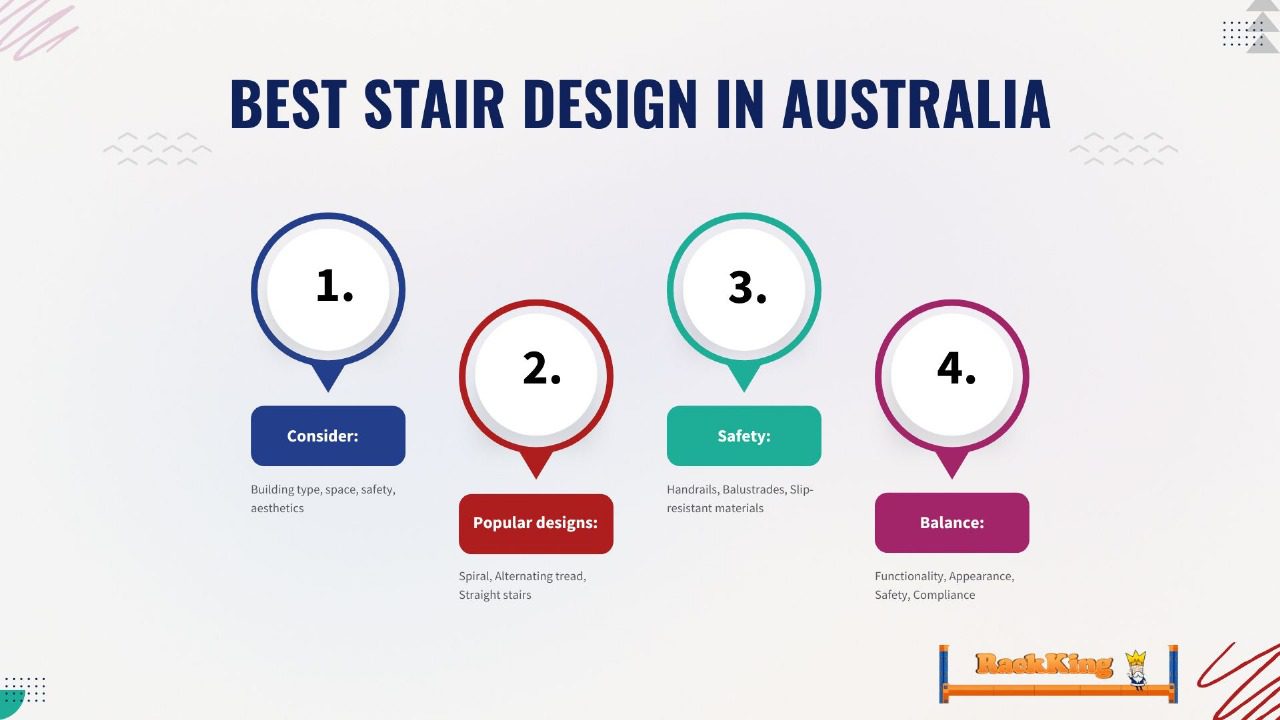
The design of a staircase is determined by the type of building and the available space. Industrial and warehouse areas require structures that are both strong and functional, while public and office spaces may need designs that are also modern and elegant.
Stair design Australia is available in several styles.
- Stairs for large, busy spaces.
- Spiral stairways are great for spaces with a limited amount of space.
- Alternating tread stairs can be used in small spaces to provide quick access.
Safety should be a top priority. By adding balustrades, secure handrails, and stairs to the design of your home or business, you can provide safety and confidence for everyone. Handrails of between 900 and 1100 mm height are perfect for gripping and comfort. Balustrades over 1 meter in height will prevent any accidental falls.
The stairs in modern buildings are not only functional but also aesthetically pleasing. Stairs can match interior themes with smooth finishes, bold colors, or minimalist looks, while remaining fully compliant. When choosing a design, you must balance function, appearance, and safety. Each project should adhere to the standard stairs guidelines while meeting the building’s purpose and user needs.
Best Stair Design in Australia
Why Choose Sydney Steel Stairs Or Rackking Australia ?
Rackking stands out as a partner with Sydney Steel Stairs in the field of stair building. Together, they deliver BCA-Compliant Stairs Australia that meets the highest levels of safety and craftsmanship.
Their partnership is centered on:
- BCA-compliant design that meets national and local standards.
- Australian materials are designed to withstand heavy industry.
- Full-service, from design through fabrication to installation.
Each project is treated with precision. This ensures that every detail is done correctly the first time. They have a simple philosophy: “Build the project right the first time.”
Both companies have years’ experience in stair designing in Australia. They work closely with customers to produce stairs that are not only compliant but also efficient and visually appealing. The service they offer is one that offers confidence, safety, as well as quality for years to come.
Conclusion
BCA Compliant Stairs, which are required in every Australian construction, provide safety through structure. These stairways are built to reduce risks, protect lives, and improve daily mobility. To follow the Australian Standards for Stairs is more than meeting rules. It involves building trust and a sense of responsibility into each step.
Whether it’s indoor solutions or outdoor stairs, compliance is what ensures safety and beauty. Rack king can provide stair solutions that are compliant with these standards. It offers peace of mind by combining strength, safety, and design, making BCA Compliant Staircases the smart choice for any project.
Also Read
Mesh Load Decks Benefits, Installation & Usage in Warehouses
Proper Pallet Racking Installation for Safe Warehouses- A Guide
FAQs
Why is BCA Compliance important in Australia for Stairs?
It is important to have them because they can keep people safer, ensure the building follows the law, and that every step is solid and balanced.
What are the materials that make for safe stairs?
Steel and Stainless Steel are the ideal materials, as they are long-lasting and safe, both indoors and out.
Where can I find BCA-compliant staircases in Australia that are reliable?
Rackking Sydney Steel Stairs is a trusted provider known for creating safe, modern, fully compliant, and highly compliant stair systems across Australia.